UNITED STATES
SECURITIES AND EXCHANGE COMMISSION
Washington, D.C. 20549
SCHEDULE 14A
(Rule 14a-101)
SCHEDULE 14A INFORMATION
Proxy Statement Pursuant to Section 14(a) of the
Securities Exchange Act of 1934 (Amendment No. )
Filed by the Registrant x
Filed by a Party other than the Registrant o
Check the appropriate box:
o | Preliminary Proxy Statement | ||||
| o | Confidential, for Use of the Commission Only (as permitted by Rule 14a-6(e)(2)) | ||||
x | Definitive Proxy Statement | ||||
| o | Definitive Additional Materials | ||||
| o | Soliciting Material Pursuant to §240.14a-12 | ||||
(Name of registrant as specified in its charter)
(Name of Person(s) Filing Proxy Statement, if other than the Registrant)
Payment of Filing Fee (Check the appropriate box):
| x | No fee required. | ||||
| o | Fee paid previously with preliminary materials. | ||||
| o | Fee computed on table in exhibit required by Item 25(b) per Exchange Act Rules 14a-6(i)(1) and 0-11. | ||||

EDITAS MEDICINE, INC.
11 Hurley Street
Cambridge, Massachusetts 02141
NOTICE OF 2026 ANNUAL MEETING OF STOCKHOLDERS
To be held on Wednesday, June 17, 2026
You are cordially invited to attend the 2026 Annual Meeting of Stockholders (the “Annual Meeting”) of Editas Medicine, Inc., which is scheduled to be held via the Internet at a virtual web conference at www.virtualshareholdermeeting.com/EDIT2026 on Wednesday, June 17, 2026 at 8:30 a.m. Eastern Time. There will not be a physical meeting location, and stockholders will not be able to attend the Annual Meeting in person. We believe that the virtual meeting format provides expanded access to our stockholders, and improved communication and cost savings for our stockholders and our company. The logistics of the virtual meeting are discussed more fully in the attached proxy statement. This means that you can attend the Annual Meeting online, vote your shares during the online meeting and submit questions during the online meeting by visiting the above-mentioned Internet site.
Only stockholders who owned common stock at the close of business on April 20, 2026 can vote during the Annual Meeting or any adjournment that may take place. At the Annual Meeting, the stockholders will consider and vote on the following matters:
1.Election of two Class I directors to our board of directors, each to serve until the 2029 annual meeting of stockholders;
2.Approval, on an advisory basis, of the compensation paid to our named executive officers;
3.Ratification of the appointment of PricewaterhouseCoopers LLP as our independent registered public accounting firm for the fiscal year ending December 31, 2026; and
4.Transaction of any other business properly brought before the Annual Meeting or any adjournment or postponement of the Annual Meeting.
You can find more information regarding the foregoing in the attached proxy statement.
Instead of mailing a printed copy of our proxy materials to all of our stockholders, we provide access to these materials via the Internet. This reduces the amount of paper necessary to produce these materials as well as the costs associated with mailing these materials to all stockholders. Accordingly, on or about April 28, 2026, we will begin mailing a Notice of Internet Availability of Proxy Materials (“Notice”) to all stockholders of record on our books at the close of business on April 20, 2026, the record date for the Annual Meeting, and will post our proxy materials on the website referenced in the Notice. As more fully described in the Notice, stockholders may choose to access our proxy materials on the website referred to in the Notice or may request to receive a printed set of our proxy materials. In addition, the Notice and website provide information regarding how you may request to receive proxy materials in printed form by mail, or electronically by email, on an ongoing basis.
If you are a stockholder of record, you may vote in one of the following ways:
•Vote over the Internet, by going to www.proxyvote.com (have your proxy card in hand when you access the website);
•Vote by Telephone, by calling the toll-free number 1-800-690-6903 (have your proxy card in hand when you call);
•Vote by Mail, if you received (or requested and received) a printed copy of the proxy materials, by completing, signing and dating the proxy card provided to you and returning it in the prepaid envelope provided to you; or
•Vote during the virtual Annual Meeting, by going to www.virtualshareholdermeeting.com/EDIT2026 at the scheduled time of the meeting (have your Notice and control number found on your proxy card in hand).
A complete list of registered stockholders will be available to stockholders of record for inspection at our offices at 11 Hurley St., Cambridge, Massachusetts 02141 for a period of ten days prior to the Annual Meeting. If your shares are held in “street name,” that is, held for your account by a bank, broker or other nominee, you will receive instructions from the holder of record that you must follow for your shares to be voted.
Whether or not you plan to attend the Annual Meeting online, we urge you to take the time to vote your shares.
By Order of the Board of Directors,
Gilmore O’Neill
President and Chief Executive Officer
Cambridge, Massachusetts
April 28, 2026
Proxy Statement
Table of Contents
| Page | |||||
EDITAS MEDICINE, INC.
11 Hurley Street
Cambridge, Massachusetts 02141
617-401-9000
PROXY STATEMENT
FOR THE 2026 ANNUAL MEETING OF STOCKHOLDERS
to be held on Wednesday, June 17, 2026
This proxy statement (the “Proxy Statement”) and the enclosed proxy card contain information about the Annual Meeting of Stockholders of Editas Medicine, Inc. (the “Annual Meeting”) to be held via the Internet at a virtual web conference at www.virtualshareholdermeeting.com/EDIT2026 on Wednesday, June 17, 2026 at 8:30 a.m. Eastern Time. There will not be a physical meeting location, and stockholders will not be able to attend the Annual Meeting in person. We believe that the virtual meeting format provides expanded access to our stockholders, and improved communication and cost savings for our stockholders and our company. The logistics of the virtual meeting are discussed more fully in this Proxy Statement. This means that you can attend the Annual Meeting online, vote your shares during the online meeting and submit questions during the online meeting by visiting the above-mentioned Internet site. The board of directors of Editas (the “Board”) is using this Proxy Statement to solicit proxies for use at the Annual Meeting. In this Proxy Statement, unless expressly stated otherwise or the context otherwise requires, the use of “Editas,” “our,” “we” or “us” refers to Editas Medicine, Inc.
Important Notice Regarding the Availability of Proxy Materials for
the Annual Meeting of Stockholders to be held on Wednesday, June 17, 2026:
This Proxy Statement and our 2025 Annual Report to Stockholders are
available for viewing, printing and downloading at http://www.proxyvote.com.
A copy of our Annual Report on Form 10-K for the fiscal year ended December 31, 2025 (the “2025 Annual Report”) as filed with the Securities and Exchange Commission (“SEC”), except for exhibits, will be furnished without charge to any stockholder upon written request to Editas Medicine, Inc., 11 Hurley Street, Cambridge, Massachusetts 02141. This Proxy Statement and our 2025 Annual Report are also available on the SEC’s website at http://www.sec.gov.
On or about April 28, 2026, we will mail a Notice of Internet Availability of Proxy Materials (“Notice”) to our stockholders (other than those who previously requested electronic or paper delivery of proxy materials), directing stockholders to a website where they can access our proxy materials, including this Proxy Statement and our 2025 Annual Report, and view instructions on how to vote online or by telephone. If you would prefer to receive a paper copy of our proxy materials, please follow the instructions included in the Notice. If you have previously elected to receive our proxy materials electronically, you will continue to receive access to those materials via e-mail unless you elect otherwise.
1
Proxy Statement Summary
This summary highlights information related to topics discussed throughout this Proxy Statement. This summary does not contain all of the information that you should consider, and you should read the entire Proxy Statement carefully before voting.
Attend our 2026 Annual Meeting of Stockholders Via Live Webcast
Wednesday, June 17, 2026 at 8:30 a.m., Eastern Time Access to Live Webcast: www.virtualshareholdermeeting.com/EDIT2026 | ||
How to Vote Prior to the Annual Meeting
By mailing your Proxy Card  | By telephone  | By Internet  | ||||||||||||
| Cast your ballot, sign your proxy card and send by free post | Dial toll-free 24/7 1-800-690-6903 | Visit 24/7 www.proxyvote.com | ||||||||||||
| Mark, sign and date your proxy card and return it in the postage-paid envelope included in your proxy materials. Your proxy card must arrive by June 16, 2026. | Use any touch-tone telephone to transmit your voting instructions up until 11:59 p.m., Eastern Time, on June 16, 2026. Have your proxy card in hand when you call and then follow the instructions. | Use the Internet to transmit your voting instructions and for electronic delivery of information up until 11:59 p.m., Eastern Time, on June 16, 2026. Have your proxy card in hand when you access the website and follow the instructions to obtain your records and to create an electronic voting instruction form. | ||||||||||||
Please note that the Annual Meeting will be held virtually, via live webcast, rather than in-person. To attend the Annual Meeting, you will need the 16-digit control number located on your Notice, on your proxy card or on the instructions that accompanied your proxy materials.
If you attend the Annual Meeting, you may vote your shares electronically during the Annual Meeting even if you have previously returned your proxy card or completed your proxy by phone or on the Internet. Stockholders wishing to vote their shares electronically during the Annual Meeting should refer to the Notice for instructions regarding voting electronically during the Annual Meeting.
Cast Your Vote Right Away
Please cast your vote right away on all of the proposals listed below to ensure that your shares are represented.
| More Information | Board of Directors Recommendation | ||||||||||
| PROPOSAL 1: | Election of Two Class I Directors | Page 11 | FOR each nominee | ||||||||
| PROPOSAL 2: | Advisory Vote on Executive Compensation | Page 59 | FOR | ||||||||
| PROPOSAL 3: | Ratification of the Appointment of PricewaterhouseCoopers LLP as Our Independent Registered Public Accounting Firm for the Fiscal Year Ending December 31, 2026 | Page 60 | FOR | ||||||||
2
Select Business Highlights
In January 2023, we announced our strategy to become a leader in in vivo gene editing, leveraging cutting edge gene editing technology to deliver transformative therapies that simplify the usability for patients, minimize the burdens to patients and healthcare systems, and are meaningfully differentiated from the current standards of care. Following scientific breakthroughs by our team, we accelerated this strategy in December 2024 by transitioning to a fully in vivo focused preclinical company with the intent of achieving in vivo human proof-of-concept within approximately two years.
In 2025, we began to see the fruits of this decision, as indicated by the below highlights.
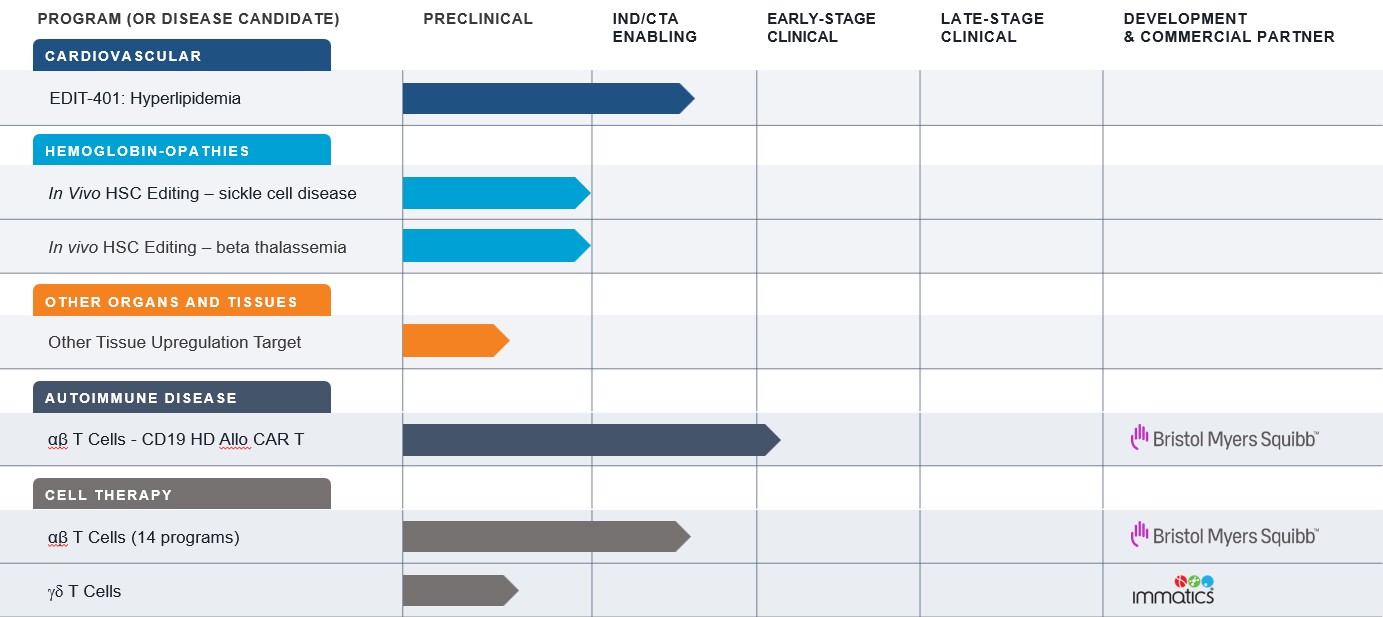
•Cardiovascular. In September 2025 we announced the nomination of our lead in vivo development candidate, EDIT-401, an experimental, potential best-in-class, one-time therapy designed to treat elevated levels of LDL-cholesterol (“LDL-C”), or hyperlipidemia, through upregulation of the LDL receptor. In preclinical studies in non-human primates, EDIT-401 has achieved LDL-C reductions exceeding 90%.
•Hemoglobinopathies. Leveraging our differentiated approach from our former reni-cel program, in January 2025, we announced in vivo preclinical proof-of-concept data of editing hematopoietic stem cells (“HSC”) in non-human primates, a key step in developing an in vivo treatment for sickle cell disease and transfusion-dependent beta thalassemia, and continued to optimize candidates for our HSC program.
•Other cells and tissues. We advanced our “plug ‘n play” lipid nanoparticle (“LNP”) platform, which is designed to enable targeted delivery of in vivo gene editing medicines to multiple cells and tissues. In the liver, using this LNP platform enables us to develop new therapies by only reprogramming guide RNAs for specific liver targets. For extrahepatic delivery, our LNP platform enables us to target multiple tissues through the substitution of different targeting ligands conjugated to the LNP.
In addition, through the use of our at-the-market offering facility and continued financial discipline, we extended our cash runway into the third quarter of 2027, placing us in a strong position to build on our achievements in 2025 and drive EDIT-401 toward upcoming milestones.
The following summarizes our current research programs and disease areas:
3
Governance Highlights
We are committed to strong corporate governance and the regular review of our corporate governance practices to continue building on our success and create long-term stockholder value. As part of our regular governance practice review, we conduct a robust stockholder outreach program to solicit and understand our stockholders’ perspectives on our practices and to better understand the reasons for their votes. We also engage with certain proxy advisory firms to understand their governance policies and related vote recommendations. Our Board and the Nominating and Corporate Governance Committee of our Board consider feedback received from this effort and other input from our stockholders and other stakeholders in determining what further governance actions, if any, are in the best interest of our company and our stockholders.
We intend to continue our stockholder outreach following the filing of this Proxy Statement with the SEC, to seek support for our annual meeting proposals and to solicit additional feedback regarding governance, compensation and other matters of importance to our stockholders.
Our current governance practices include the following:
| Board Independence | Board Refreshment | ||||||||||
•Supermajority of independent directors | •Commitment to Board refreshment, with a robust director nominee selection process | ||||||||||
•Separate Board chair and CEO roles | |||||||||||
•100% independent Board committees | •Mandatory retirement age of 75 | ||||||||||
•Regular executive sessions of independent directors | •Corporate Governance Guidelines codify our commitment to include a diverse range of qualified professionals from which Board nominees are chosen | ||||||||||
•Annual Board and committee evaluations | |||||||||||
•Overboarding limits for directors | |||||||||||
| Stockholder Rights and Interests | Robust Governance Practices | ||||||||||
•Annual “say-on-pay” vote | •Board-level oversight of material enterprise risks | ||||||||||
•One single voting class of common stock •Proactive annual stockholder engagement program that includes director participation •No shareholder rights plan (i.e., no “poison pill”) | •Management gives periodic reports to the Board or its Committees on cybersecurity risks •Clawback policy and clawback provisions in equity award agreements •Prohibition on hedging and pledging shares of company stock by executive officers and directors | ||||||||||
Director Nominees
The following table provides summary information regarding our two director nominees. For detailed information about each nominee’s background and areas of expertise, please see “Proposal No. 1—Election of Two Class I Directors.”
| Director Since | Independent | Other Public Company Boards | ||||||||||||||||||||||||||||||||||||
| Name and Occupation | Age* | Yes | No | Committee Memberships* | ||||||||||||||||||||||||||||||||||
Bernadette Connaughton Former President Intercontinental of Bristol Myers Squibb Company | 67 | 2021 | X | Compensation (Chair) Nominating | 1 | |||||||||||||||||||||||||||||||||
Elliott Levy Venture Partner at 5AM Venture Management, LLC | 67 | 2023 | X | Audit | 1 | |||||||||||||||||||||||||||||||||
*As of April 20, 2026
4
Executive Compensation Highlights
Our executive compensation program is designed to support business performance and drive long-term stockholder value. Below are highlights of our executive compensation program.
| Compensation Highlights | |||||||||||||||||
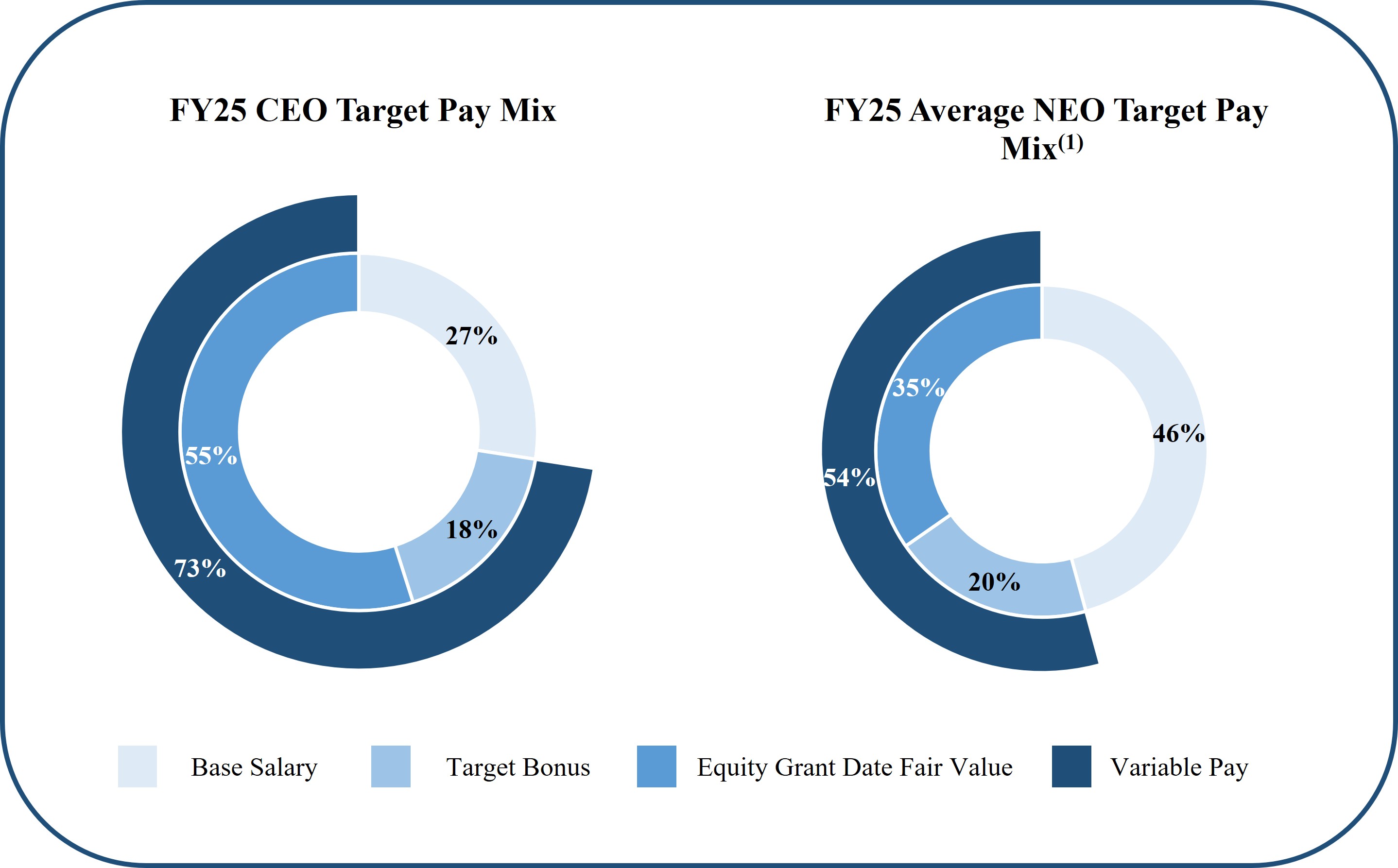
Significant portion of named executive officers’ target compensation is performance-based (see below chart) ◦Approximately 73% for CEO ◦Approximately 54% for other named executive officers | Annual performance-based cash bonus program for other named executive officers tied 80% to corporate achievement and 20% to individual achievement | ||||||||||||||||
| Annual performance-based cash bonus program for Chief Executive Officer tied 100% to corporate achievement | Demonstrating our pay for performance culture, our Board determined that our corporate objectives were achieved at 91% of target for purposes of our performance-based cash bonus program. See “Executive Compensation—Overview of Executive Compensation—Executive Compensation Elements & Decisions” for a discussion of the Board’s considerations | ||||||||||||||||
2025 Executive Target Compensation Mix
The charts below illustrate the target 2025 pay mix (excluding benefits) for Gilmore O’Neill, our Chief Executive Officer, and for our other named executive officers, Linda C. Burkly, Ph.D., our Chief Scientific Officer, and Amy Parison, our Chief Financial Officer. Please see “Executive Compensation—2025 Summary Compensation Table” for amounts actually earned by each of them.
________________________
(1)Ms. Parison’s initial base annual salary for 2025 was $340,000 but was increased to $415,000 in connection with her promotion in March 2025 to Chief Financial Officer. For purposes of this chart, her base annual salary following promotion has been annualized.
5
Transition to All Options in Executive Equity Award Program
In connection with our acceleration from a clinical-stage company with both in vivo and ex vivo programs to a fully in vivo focused preclinical company in December 2024, we updated our peer group to align with our new preclinical status and new corporate size and strategy. At that time, we reevaluated the structure of our equity incentive program to ensure alignment with this updated peer group and our new company profile and strategy. In February 2025, our Organization, Leadership, and Compensation Committee (“Compensation Committee”) determined that all employees would receive only time-based vesting stock options rather than a mix of time-based vesting restricted stock units (“RSUs”) and time-based vesting stock options, as had been awarded to employees in the past. For our officers, including the named executive officers, the Compensation Committee also determined to no longer award performance-based restricted stock units (“PSUs”), as it had done in previous years. The Compensation Committee determined that this transition in the type of equity awards made was appropriate in order to create momentum to drive long-term stockholder value and simplify the equity compensation program for our employees. This transition also reflects the guidance of the Compensation Committee’s independent compensation consultant that RSUs and PSUs are less common among preclinical biotechnology companies, including other companies in our updated peer group. The Compensation Committee believes that options are performance-based equity awards, particularly with our typical four-year vesting period, since the recipient recognizes value only if the company achieves objectives that result in recognized stockholder value and our stock price appreciates over time.
6
Stockholder Engagement Highlights
Stockholder Outreach
We are committed to strong corporate governance and the regular review of our corporate governance practices to continue building on our success and to create long-term stockholder value. As part of our regular corporate governance practice review, we conduct a robust stockholder outreach program to solicit and understand our stockholders’ perspectives on our practices and to better understand the reasons for their votes. We also engage with certain proxy advisory firms to understand their governance policies and related vote recommendations. Our Board and the Nominating and Corporate Governance Committee of our Board consider feedback received from this effort and other input from our stakeholders in determining what further governance actions, if any, are in the best interest of our company and its stockholders.
During the second half of 2025, we solicited feedback from institutional investors holding approximately 35% of our outstanding shares, and received feedback from investors holding approximately 12% of our outstanding shares. Our integrated engagement team included our Chief Financial Officer, our General Counsel, the head of our human resources team, and our investor relations team, and in certain engagements the chair of our Compensation Committee participated. We discussed numerous topics of stockholder interest, including our most recent “say on pay” vote results, corporate strategy, corporate governance, board skills and leadership, and other matters.
Highlights of Engagement Regarding Executive Compensation | |||||
| What We Heard | Our Response | ||||
Use of Quantitative Metrics. Some stockholders noted a preference for more quantitative metrics as part of our annual cash bonus program. | •As a pre-commercial company, identifying quantitative metrics that support long-term stockholder value creation is challenging. However, the Compensation Committee and management strive to make our bonus program metrics objective in order to enable a clear measurement framework at year end. •For this reason, annually, the Compensation Committee sets challenging research and development, clinical, and operational qualitative and quantitative goals to drive management performance and promote value creation. •For example, our 2025 annual performance-based cash program included as milestone goals the declaration of an in vivo gene editing development candidate, creation of an integrated development plan for regulatory submission to commence a clinical trial, and delivery of drug product to enable preclinical studies to support that regulatory submission. | ||||
Pay-for-Performance Misalignment. Certain stockholders and a proxy advisory firm believed there was a pay-for-performance misalignment, particularly noting that the majority of equity awards remain time-based. | •In connection with our acceleration to a fully in vivo focused preclinical company in December 2024, the Compensation Committee reevaluated the structure of our equity incentive program to ensure alignment with our updated 2025 peer group. •This reevaluation indicated that the use of performance-based RSUs was uncommon and that peers generally granted time-based options and RSUs. •The Compensation Committee determined to transition all employee equity awards to time-based options in order to create momentum to drive long-term stockholder value and simplify the program for our employees. •In furtherance of our pay-for-performance culture, our employees now only see value in their equity awards if the company creates recognized stockholder value and the price of our stock appreciates over time. Further, the four-year vesting period used for our new hire and annual equity awards promotes long-term employee retention. •Further demonstrating our pay-for-performance culture, our Board approved that our corporate objectives were achieved at 91% of target and total compensation to our Chief Executive Officer declined compared to his 2024 total compensation. | ||||
Additional Disclosure. Certain stockholders requested that we provide additional disclosure regarding our annual cash bonus program. | •We have disclosed under “Executive Compensation” the objectives, including specified targets and achievements, taking into account the potential competitive harm that could result by disclosing sensitive achievements or strategic objectives. | ||||
7
Highlights of Engagement Regarding Governance Matters | |||||
| What We Heard | Our Response | ||||
Corporate Defensive Measures. Stockholders expressed a desire for us to consider certain changes to our corporate defensive measures, including our classified board structure and certain supermajority voting requirements. | •Each year our Nominating and Corporate Governance Committee reviews our governance posture in light of best practices, industry trends, stockholder feedback, and other specific characteristics or circumstances of our company at the time. The committee also considers the prevalence of the corporate defensive measures among companies of similar size and maturity in our industry. •Following this review, the Nominating and Corporate Governance Committee determined that our company and its stockholders are, at this time, best served by maintaining the current classified board structure, stockholder voting standards, and other corporate defensive measures, which are common among our peer group and are designed to enable the Board to ensure that any strategic transaction appropriately values the company and its assets. •The Nominating and Corporate Governance Committee will continue to evaluate these measures on an annual basis. | ||||
Director Skills. Stockholders discussed whether our current Board composition aligns with our strategy. | •The Nominating and Corporate Governance Committee periodically evaluates the Board’s composition, expertise, and experience to ensure that current directors complement and enhance the Board’s effectiveness. •Our current directors reflect a diverse set of backgrounds and skills, including research and development experience in genomic medicines, strategic and business development experience, and audit and financial expertise. •The Nominating and Corporate Governance Committee believes that the current composition of the Board reflects the experience and expertise appropriate to set and evaluate our strategic objectives and oversee the company. | ||||
8
IMPORTANT INFORMATION ABOUT THE ANNUAL MEETING AND VOTING
Purpose of the Annual Meeting
At the Annual Meeting, our stockholders will consider and vote on the following matters:
1.Election of two Class I directors to the Board, each to serve until the 2029 annual meeting of stockholders (“Proposal No. 1”);
2.Approval, on an advisory basis, of the compensation paid to our named executive officers (“Proposal No. 2”);
3.Ratification of the appointment of PricewaterhouseCoopers LLP as our independent registered public accounting firm for the fiscal year ending December 31, 2026 (“Proposal No. 3”); and
4.Transaction of any other business properly brought before the Annual Meeting or any adjournment or postponement of the Annual Meeting.
As of the date of this Proxy Statement, we are not aware of any business to come before the meeting other than the first three items noted above.
Board of Directors Recommendation
Our Board unanimously recommends that you vote:
FOR the election of the two nominees to serve as Class I directors on our Board, each for a three-year term;
FOR the approval, on an advisory basis, of the compensation paid to our named executive officers; and
FOR the ratification of the appointment of PricewaterhouseCoopers LLP as our independent registered public accounting firm for the fiscal year ending December 31, 2026.
Availability of Proxy Materials
The Notice regarding our proxy materials, including this Proxy Statement and our 2025 Annual Report, is being mailed to stockholders on or about April 28, 2026. Our proxy materials are also available for viewing, printing and downloading on the Internet at http://www.proxyvote.com.
Who Can Vote during the Annual Meeting
Only stockholders of record at the close of business on the record date of April 20, 2026, are entitled to receive notice of the Annual Meeting and to vote the shares of our common stock that they held on that date. As of April 20, 2026, there were 97,905,938 shares of our common stock issued and outstanding. Each share of common stock is entitled to one vote on each matter properly brought before the Annual Meeting.
Difference between a “stockholder of record” and a beneficial owner of shares held in “street name”
Stockholder of Record. If your shares are registered directly in your name with our transfer agent, Computershare Trust Company, N.A., then you are considered a “stockholder of record” of those shares. In this case, your Notice has been sent to you directly by us. You may vote your shares by proxy prior to the Annual Meeting by following the instructions contained on such Notice.
Beneficial Owners of Shares Held in Street Name. If your shares are held in a brokerage account or by a bank, trust or other nominee or custodian, then you are considered the beneficial owner of those shares, which are held in “street name.” In this case, your Notice has been forwarded to you by that organization. The organization holding your account is considered the stockholder of record for purposes of voting at the Annual Meeting. As the beneficial owner, you have the right to instruct that organization as to how to vote the shares held in your account by following the instructions contained on the voting instruction card provided to you by that organization.
How to Vote
If you are a stockholder of record, you can vote your shares in one of two ways: either by proxy or virtually during the Annual Meeting. If you choose to vote by proxy, you may do so by telephone, via the Internet or by mail. Each of these
9
methods is explained below. If you hold your shares of our common stock in multiple accounts, you should vote your shares as described in each set of proxy materials you receive.
•By Telephone. You may transmit your proxy voting instructions by calling 1-800-690-6903. You will need to have your Notice or proxy card in hand when you call.
•Via the Internet. You may transmit your proxy voting instructions via the Internet by accessing the website specified on the enclosed Notice or proxy card. You will need to have your Notice or proxy card in hand when you access the website.
•By Mail. If you received (or requested and received) a printed copy of the proxy materials, you may vote by proxy by completing, signing and dating the proxy card provided to you and returning it in the prepaid envelope provided to you.
•Voting during the Annual Meeting. You may vote during the Annual Meeting by accessing the website www.virtualshareholdermeeting.com/EDIT2026 and having your Notice or proxy card in hand. Even if you plan to attend the Annual Meeting, we urge you to vote your shares by proxy in advance of the Annual Meeting, so that if you should become unable to attend the Annual Meeting, your shares will be voted as directed by you. Online check-in will begin at 8:15 a.m. Eastern Time on June 17, 2026. We will have technicians standing by and ready to assist you with any technical difficulties you may have accessing the virtual meeting. If you encounter any difficulties accessing the virtual Annual Meeting during the check-in or meeting time, please call the technical support number that will be posted on the log-in page at www.virtualshareholdermeeting.com/EDIT2026. Technical support will be available starting at 8:15 a.m. Eastern Time on June 17, 2026.
Telephone and Internet voting prior to the Annual Meeting for stockholders of record will be available up until 11:59 p.m. Eastern Time on June 16, 2026, and mailed proxy cards must be received by June 16, 2026 in order to be counted at the Annual Meeting. If the Annual Meeting is adjourned or postponed, these deadlines may be extended.
The voting deadlines and availability of telephone and Internet voting for beneficial owners of shares held in “street name” will depend on the voting processes of the organization that holds your shares. Therefore, we urge you to carefully review and follow the voting instruction card and any other materials that you receive from that organization. If you own stock in “street name” as of the record date, you may virtually attend the Annual Meeting and vote your shares online while attending the Annual Meeting with the control number included on your voting instruction form.
Proposals Considered “Discretionary” and “Non-Discretionary”
If your shares are held in “street name,” your bank, broker or other nominee may under certain circumstances vote your shares if you do not return voting instructions. Banks, brokers or other nominees are permitted to vote customers’ shares for which they have received no voting instructions on specified routine, or “discretionary,” matters, but they are not permitted to vote these shares on other non-routine, or “non-discretionary,” matters.
The election of directors (Proposal No. 1) and the advisory vote on the compensation paid to our named executive officers (Proposal No. 2) are considered non-discretionary matters under applicable rules. Therefore, if your shares are held in “street name,” your bank, broker or other nominee cannot vote on these matters without voting instructions from you and your shares will be counted as “broker non-votes.”
The ratification of the appointment of PricewaterhouseCoopers LLP as our independent registered public accounting firm for 2026 (Proposal No. 3) is considered a discretionary matter under applicable rules. Therefore, if your shares are held in “street name,” your bank, broker or other nominee may exercise discretionary authority to vote on this matter in the absence of voting instructions from you.
Quorum
A quorum of stockholders is necessary to hold a valid meeting. Our amended and restated by-laws provide that a quorum will exist if stockholders holding a majority of the shares of stock issued and outstanding and entitled to vote are present at the meeting virtually or by proxy. If a quorum is not present, the meeting may be adjourned until a quorum is obtained.
For purposes of determining whether a quorum exists, we will count as present any shares that are voted over the Internet, by telephone, by completing and submitting a proxy by mail or that are represented virtually at the Annual Meeting. Further, for purposes of establishing a quorum, we will count as present shares that a stockholder holds even if the stockholder votes to abstain or only votes on one of the proposals. In addition, we will count as present shares that are “broker non-votes.”
10
Stockholder List
A complete list of registered stockholders will be available to stockholders of record for inspection at our offices at 11 Hurley St., Cambridge, Massachusetts 02141 for a period of ten days prior to the Annual Meeting. If you are unable to inspect this list in person, please contact our secretary by mail at Editas Medicine, Inc., 11 Hurley Street, Cambridge, Massachusetts 02141, Attention: Secretary, or by email at legal@editasmed.com to request such list. When making such request, please ensure that you have your Notice or proxy card available so that you can prove that you a registered stockholder.
Votes Required to Approve Proposals
To be elected, a director must receive a plurality of the votes cast by stockholders entitled to vote on the election of directors (Proposal No. 1). Votes that are withheld will not be included in the vote tally for Proposal No. 1 and will not affect the results of the vote. With respect to Proposal No. 1, you may vote for all nominees, vote for one or more nominees and withhold your vote for the other nominees, or withhold your vote from all nominees.
To approve, on an advisory basis, the compensation paid to our named executive officers (Proposal No. 2), the holders of a majority of the shares voted on the matter and voting “for” or “against” such proposal must vote FOR the proposal. Because this vote is advisory and not binding on us or the Board in any way, the Board may decide that it is in our and our stockholders’ best interests to compensate our named executive officers in an amount or manner that differs from that which is approved by our stockholders.
The ratification of the appointment of PricewaterhouseCoopers LLP as our independent registered public accounting firm requires the affirmative vote of a majority of the shares of common stock present or represented by proxy and voted “for” or “against” such matter (Proposal No. 3). If your shares are held by your brokerage firm in “street name” and you do not provide voting instructions with respect to your shares, your brokerage firm may vote your shares on Proposal 3. Although stockholder ratification of the Audit Committee’s appointment of PricewaterhouseCoopers LLP as our independent registered public accounting firm for the fiscal year ending December 31, 2026 is not required, we believe that it is advisable to give stockholders an opportunity to ratify this appointment. If this proposal is not approved at the Annual Meeting, the Audit Committee may reconsider its appointment of PricewaterhouseCoopers LLP as our independent registered public accounting firm for the year ended December 31, 2026.
Abstentions and broker non-votes will not be counted as votes cast or voted on any of the proposals. Accordingly, abstentions and broker non-votes will have no effect on the voting on any of the proposals.
Method of Counting Votes
Each holder of common stock is entitled to one vote at the Annual Meeting on each matter to come before the Annual Meeting, including the election of directors, for each share held by such stockholder as of the record date. Votes cast virtually during the Annual Meeting or by proxy by mail, via the Internet or by telephone will be tabulated by the inspector of election appointed for the Annual Meeting, who will also determine whether a quorum is present.
Revoking a Proxy; Changing Your Vote
If you are a stockholder of record, you may revoke your proxy before the vote is taken at the meeting:
•by submitting a new proxy with a later date before the applicable deadline either signed and returned by mail or transmitted using the telephone or Internet voting procedures described in the “How to Vote” section above;
•by voting online during the meeting; or
•by filing a written revocation with our corporate secretary.
If your shares are held in “street name,” you may submit new voting instructions by contacting your bank, broker or other organization holding your account. If you own stock in “street name” as of the record date, you may virtually attend the meeting and vote your shares online during the meeting with your control number included on your voting instruction form.
Your virtual attendance at the Annual Meeting will not automatically revoke your proxy.
11
Questions at the Annual Meeting
If you wish to submit a question on the day of the Annual Meeting, beginning at 8:15 a.m. Eastern Time, on Wednesday, June 17, 2026, you may log into, and ask a question on, the virtual meeting platform at www.virtualshareholdermeeting.com/EDIT2026. Our virtual Annual Meeting will be governed by our Rules of Conduct which will be posted in advance of the meeting on the virtual meeting platform. The Rules of Conduct will address the ability of stockholders to ask questions during the meeting, including rules on permissible topics, and rules for how questions and comments will be recognized and disclosed to meeting participants.
Costs of Proxy Solicitation
We will bear the costs of soliciting proxies. In addition to solicitations by mail, our directors, officers and regular employees, without additional remuneration, may solicit proxies by telephone, facsimile, email, personal interviews and other means. We have retained Georgeson LLC to assist in the solicitation of proxies for a fee of approximately $17,000 plus customary costs and expenses for these services.
Voting Results
We plan to announce preliminary voting results at the Annual Meeting and will publish final results in a Current Report on Form 8-K to be filed with the SEC within four business days following the Annual Meeting.
12
PROPOSAL NO. 1—ELECTION OF TWO CLASS I DIRECTORS
As of the date of this Proxy Statement, our Board consists of six members, including a chair of the Board. In accordance with the terms of our restated certificate of incorporation and our amended and restated by-laws, our board of directors is divided into three classes (Class I, Class II and Class III), with members of each class serving staggered three-year terms. The members of the classes are divided as follows:
•the Class I directors are Bernadette Connaughton and Elliott Levy, M.D., and their terms will expire at the Annual Meeting;
•the Class II directors are Andrew Hirsch and Gilmore O’Neill, M.B., M.M.Sc., and their terms will expire at the annual meeting of stockholders to be held in 2027; and
•the Class III directors are Jessica Hopfield, Ph.D., and David T. Scadden, M.D., and their terms will expire at the annual meeting of stockholders to be held in 2028.
Upon the expiration of the term of a class of directors, directors in that class will be eligible to be elected for a new three-year term at the annual meeting of stockholders in the year in which their term expires.
Our restated certificate of incorporation and our amended and restated by-laws provide that the authorized number of directors may be changed only by resolution of our Board. Our restated certificate of incorporation and amended and restated by-laws also provide that our directors may be removed only for cause by the affirmative vote of the holders of at least 75% of the votes that all our stockholders would be entitled to cast in an annual election of directors, and that any vacancy on our Board, including a vacancy resulting from an enlargement of our Board, may be filled only by vote of a majority of our directors then in office.
Our Board has nominated Ms. Connaughton and Dr. Levy for election as Class I directors at the Annual Meeting. Each of the nominees is presently a director, and each has indicated a willingness to continue to serve as director, if elected. If a nominee becomes unable or unwilling to serve, however, the proxies may be voted for substitute nominees selected by our Board.
We believe that it is essential that our Board members represent diverse backgrounds and experiences, both personally and professionally. Our amended Corporate Governance Guidelines provide that director candidates should have broad experience and skills in areas important to the operation of our company. Accordingly, the charter of our Nominating and Corporate Governance Committee states that, in recommending directors, the committee shall seek director candidates that have such broad experience, skills and diversity. We believe that the backgrounds and qualifications of our directors, considered as a group, should provide a significant breadth of experience, knowledge, and ability to assist our Board in fulfilling its responsibilities.
Our priority in selection of Board members is identification of members who will further the interests of our stockholders, and in this context, we consider a variety of attributes in selecting nominees to our Board, including:
•an understanding of, and experience in, the biotechnology and pharmaceutical industries, research and academic organizations and governmental regulatory agencies, and the scientific and legal landscapes in which such entities operate;
•an understanding of, and experience in, accounting oversight and governance, finance, and complex business transactions;
•leadership experience and significant accomplishments with public companies or other comparable organizations;
•the ability to contribute positively to the collaborative culture among our Board members;
•long-term reputation for the highest personal and professional integrity; and
•demonstrated contribution as a member of other boards of directors, and sufficient time and availability to devote to our affairs.
These factors and others are considered useful by our Board and are reviewed in the context of an assessment of the perceived needs of our Board at a particular point in time.
Nominees for Election as Class I Directors
Biographical information, including principal occupation and business experience during the last five years, for our nominees for election as Class I directors at our Annual Meeting is set forth below.
13
Class I Directors (Term Expires at 2026 Annual Meeting)
 | Bernadette Connaughton Age: 67 Director since 2021 Independent Director Committees: Compensation (Chair), Nominating and Corporate Governance | |||||||
Ms. Connaughton has served as a member of our Board since October 2021. Ms. Connaughton was previously employed by Bristol Myers Squibb Company, a multinational pharmaceutical company, in various roles from 1983 to 2017, most recently serving as President Intercontinental, including China, Latin America, Central and Eastern Europe and the Middle East. She has served on the board of directors of Halozyme Therapeutics, Inc., a public biotechnology company, since September 2018. She previously served on the board of directors of Zealand Pharma A/S, a public biotechnology company, from April 2019 until March 2026, and Syneos Health, Inc., a public contract research organization, from November 2019 until September 2023. She also serves on the Board of Trustees of the Boys and Girls Club of Mercer County, New Jersey, and is a mentor for the Healthcare Businesswomen’s Association and Women in Bio Boardroom Ready Program. She received a B.A. from Johns Hopkins University and an M.B.A. from The Wharton School, University of Pennsylvania.
Skills and Qualifications: We believe Ms. Connaughton is qualified to serve on our Board due to her more than 30 years of global strategic, commercial and biopharmaceutical industry expertise.
 | Elliott Levy, M.D. Age: 67 Director since 2023 Independent Director Committees: Audit | |||||||
Dr. Levy has served as a member of our Board since April 2023. Dr. Levy is currently a Venture Partner at 5AM Venture Management, LLC, a venture capital firm, which he joined in April 2022. He was previously employed at Amgen, Inc., a public biopharmaceutical company, where he served as Senior Vice President of Research and Development from June 2020 to May 2021 and as Senior Vice President of Global Development from September 2014 to June 2020. He has served on the board of directors of NuCana plc, a public biotechnology company, since November 2021. He previously served on the board of directors of Omega Therapeutics, Inc., a public biotechnology company, from March 2021 until August 2025, and is a co-founder and former Chief Executive Officer of Intrepid Alliance, an industry-led non-profit consortium whose objective is to accelerate the development of small molecule therapeutics for potential viral pandemic agents. Dr. Levy received a B.A. in History from Yale College and an M.D. from the Yale School of Medicine.
Skills and Qualifications: We believe Dr. Levy is qualified to serve on our Board due to his extensive experience in clinical development and regulatory approval of investigational medicines in the biopharmaceutical industry.
Our Board recommends voting “FOR” the election of Bernadette Connaughton and Elliott Levy as Class I directors, for a three-year term ending at the annual meeting of stockholders to be held in 2029.
Any properly submitted proxy will be voted in favor of the nominees unless a contrary specification is made in the proxy. The nominees have consented to serve as directors if elected. However, if any nominee is unable to serve or for good cause will not serve as a director, the persons named in the proxy intend to vote in their discretion for one or more substitutes who will be designated by our Board.
Directors Continuing in Office
Biographical information, including principal occupation and business experience during the last five years, for our current directors continuing in office after the Annual Meeting is set forth below.
14
Class II Directors (Term Expires at 2027 Annual Meeting)
 | Andrew Hirsch Age: 55 Director since 2017 Independent Director Committees: Audit (Chair), Compensation | |||||||
Mr. Hirsch has served as a member of our Board since May 2017. Mr. Hirsch has served as a director and as the President of C4 Therapeutics, Inc., a public biopharmaceutical company, since September 2020 and as its Chief Executive Officer since October 2020. From September 2016 to September 2020, Mr. Hirsch served as Chief Financial Officer at Agios Pharmaceuticals, Inc. (“Agios”), a public biotechnology company, as well as head of its corporate development beginning March 2018. He served as President and Chief Executive Officer of BIND Therapeutics, Inc., a biotechnology company (“BIND”), from March 2015 until August 2016. Prior to being named President and Chief Executive Officer at BIND, Mr. Hirsch held several other leadership positions at BIND, including Chief Operating Officer from February 2014 to March 2015, and Chief Financial Officer from July 2012 to March 2015. In May 2016, BIND filed a voluntary petition for bankruptcy under Chapter 11 of the United States Bankruptcy Code with the United States Bankruptcy Court. Prior to joining BIND, Mr. Hirsch was Chief Financial Officer at Avila Therapeutics, Inc., a biotechnology company, from June 2011 until its acquisition by Celgene Corporation, a public biopharmaceutical company, in March 2012. From 2002 to 2011, Mr. Hirsch held roles of increasing responsibility at Biogen Inc., a public biotechnology company (“Biogen”), including vice president of Corporate Strategy and M&A. He holds an M.B.A. from the Tuck School at Dartmouth College and a B.A. in Economics from the University of Pennsylvania.
Skills and Qualifications: We believe Mr. Hirsch’s qualifications to sit on our Board include his strong business and financial background and experience as an executive at biopharmaceutical companies.
 | Gilmore O’Neill, M.B., M.M.Sc. Age: 61 Director since 2022 President and Chief Executive Officer of Editas Medicine | |||||||
Dr. O’Neill has served as our President and Chief Executive Officer and as a member of our Board since June 2022. Prior to joining Editas, Dr. O’Neill most recently served as Executive Vice President of R&D and Chief Medical Officer of Sarepta Therapeutics, Inc., a biopharmaceutical company, from June 2018 to November 2021. Prior to joining Sarepta, Dr. O’Neill held several leadership roles at Biogen over a 15-year period, most recently serving as Senior Vice President, Late Stage Clinical Development from November 2016 to June 2018. He previously served on the board of directors of Unity Biotechnology, Inc., a public biopharmaceutical company, from December 2020 until June 2025, and Aptinyx, Inc., a public biopharmaceutical company, from October 2021 through April 2023. Dr. O’Neill is licensed to practice medicine in the state of Massachusetts. He received a Bachelor of Medicine degree from University College Dublin and a Master of Medical Sciences degree from Harvard University.
Skills and Qualifications: We believe Dr. O’Neill’s qualifications to sit on our Board include his more than 20 years of experience in genetic medicine, neurobiology, and clinical development, during which he has led several successful clinical programs and achieved marketing approval for several medicines.
Class III Directors (Term Expires at 2028 Annual Meeting)
 | Jessica Hopfield, Ph.D. Age: 61 Director since 2018 Board Chair; Independent Director Committees: Audit, Nominating and Corporate Governance (Chair) | |||||||
Dr. Hopfield joined our Board in February 2018 and has served as Chair since December 2024. Previously, she served as our lead independent director from February 2021 to June 2023. Dr. Hopfield has served on the board of directors of
15
Insulet Corporation, a public medical device company (“Insulet”) since July 2015 and as its lead independent director from August 2016 until January 2019. She previously served on the board of directors of Maravai LifeSciences Holdings, Inc., a public diagnostic and reagent company, from November 2020 until October 2025, Radius Health, Inc., a public biopharmaceutical company, from January 2019 until December 2020 and PhenomeX Inc. (formerly Berkeley Lights, Inc.), a public medical device company, from December 2021 until its acquisition in October 2023. Since 2010, Dr. Hopfield has been the principal at J Hopfield Consulting providing guidance and executive coaching to start-up technology firms. From 1995 to 2009, Dr. Hopfield was a Partner of McKinsey & Company in its global pharmaceuticals and medical devices practice where she served clients across pharmaceutical, biotechnology, medical device and consumer industries with a focus on strategy, R&D management, and marketing. Dr. Hopfield also previously held management positions at Merck Sharp & Dohme Corp. in clinical development, outcomes research, and marketing. Dr. Hopfield earned a B.S. from Yale College, an M.B.A. from Harvard Graduate School of Business Administration as a Baker Scholar, and a Ph.D. in Neuroscience/Biochemistry from The Rockefeller University. Dr. Hopfield is directorship certified by the National Association of Corporate Directors.
Skills and Qualifications: We believe that Dr. Hopfield’s executive and consulting experience in the healthcare, pharmaceutical, and medical device industries and her public company governance experience qualifies her to serve as a member of our Board.
 | David Scadden, M.D. Age: 73 Director since 2019 Independent Director Committees: Compensation | |||||||
Dr. Scadden joined our Board in February 2019. Dr. Scadden is the Gerald and Darlene Jordan Professor of Medicine at Harvard University, a position he has held since 2006. Since 1995, Dr. Scadden has practiced at the Massachusetts General Hospital, where he founded and directs the Center for Regenerative Medicine and directed the Hematologic Malignancies Center of the MGH Cancer Center for 10 years. Dr. Scadden co-founded and co-directs the Harvard Stem Cell Institute and is Chairman emeritus and Professor of the Harvard University Department of Stem Cell and Regenerative Biology. He is a member of the National Academy of Medicine and the American Academy of Arts and Sciences and a Fellow of the American College of Physicians and the American Academy for the Advancement of Science. He is a former member of the Board of External Experts for the National Heart, Lung and Blood Institute, the Board of Scientific Counselors for the National Cancer Institute and Board of Directors of the International Society for Stem Cell Research. Dr. Scadden has served on the board of directors of Agios since May 2017. Previously, he served on the board of directors of Carisma Therapeutics Inc., a public clinical-stage biopharmaceutical company, from June 2024 until October 2025, and Magenta Therapeutics, Inc., a public biotechnology company where he was a scientific founder, from November 2016 until its acquisition in September 2023. He also serves as a member of the board of directors of private biotechnology companies Lightning Biotherapeutics and Sonata Therapeutics. Dr. Scadden holds a B.A. in English from Bucknell University, an M.D. from Case Western Reserve University and holds honorary degrees, including an A.M. from Harvard Medical School, an Sc.D. from Bucknell University and an M.D. from Lund University in Sweden.
Skills and Qualifications: We believe Dr. Scadden is qualified to serve on our Board due to his expertise as a physician and medical researcher, including in the field of hematology.
There are no family relationships between or among any of our directors or executive officers. The principal occupation and employment during the past five years of each of our directors was carried on, in each case except as specifically identified above, with a corporation or organization that is not a parent, subsidiary or other affiliate of us. There is no arrangement or understanding between any of our directors and any other person or persons pursuant to which he or she is to be selected as a director.
There are no material legal proceedings to which any of our directors is a party adverse to us or any of our subsidiaries or in which any such person has a material interest adverse to us or any of our subsidiaries.
Executive Officers Who Are Not Directors
Executive officers are chosen by and serve at the discretion of the Board of Directors. Set forth below are the names and ages of our executive officers as of April 20, 2026, as well as biographical information for all but Gilmore O’Neill, our President and Chief Executive Officer. For Dr. O’Neill’s biographical information, please see page above.
16
 | Linda C. Burkly, Ph.D. Age: 69 Executive Vice President and Chief Scientific Officer Joined Editas in 2023 | |||||||
Dr. Burkly has served as our Chief Scientific Officer since July 2023. Prior to joining us, Dr. Burkly held positions of increasing responsibility over a 37-year tenure at Biogen Inc., where she most recently served as Vice President and Senior Distinguished Investigator from 2014 to 2022. Dr. Burkly earned a B.S. in biology from Fairfield University and a Ph.D. in immunology from Tufts University Graduate School of Biomedical Science. She completed a postdoctoral fellowship in the laboratory of Richard A. Flavell, Biogen Research Corp.
 | Amy Parison Age: 40 Senior Vice President and Chief Financial Officer Joined Editas in 2022 | |||||||
Ms. Parison was appointed our Chief Financial Officer in March 2025, having previously served as our Senior Vice President, Finance since January 2025, and prior to that as Vice President of Finance and Corporate Controller since August 2022. She served as Senior Director, Corporate Controller at Rubius Therapeutics, Inc., a biotechnology company, from July 2021 through August 2022 and prior to that as Director, Financial Operations from August 2018 through August 2021. Before that, she held roles of increasing responsibility at Vertex Pharmaceuticals Incorporated from July 2011 through August 2018. Ms. Parison received a Masters in Accounting and a B.S. in business administration, accounting from Babson College.
17
CORPORATE GOVERNANCE
Stockholder Engagement
We believe part of effective corporate governance includes active engagement with our stockholders. We value the views of our stockholders and other stakeholders, and we communicate with them regularly and solicit input on a number of topics such as our business strategy, status of our programs, our executive compensation program and general corporate governance topics. We strive for a collaborative approach and value the variety of perspectives we receive, which deepens our understanding of stakeholder interests and motivations and fosters a mutual understanding of governance priorities. Our discussions with our investors have been productive and informative, and have provided valuable feedback to our executive management team and our Board to help ensure that our decisions are aligned with stockholder objectives. We remain committed to investing time with our stockholders to increase transparency and better understand our stockholder base and their perspectives. The typical outreach participants and methods are shown below.
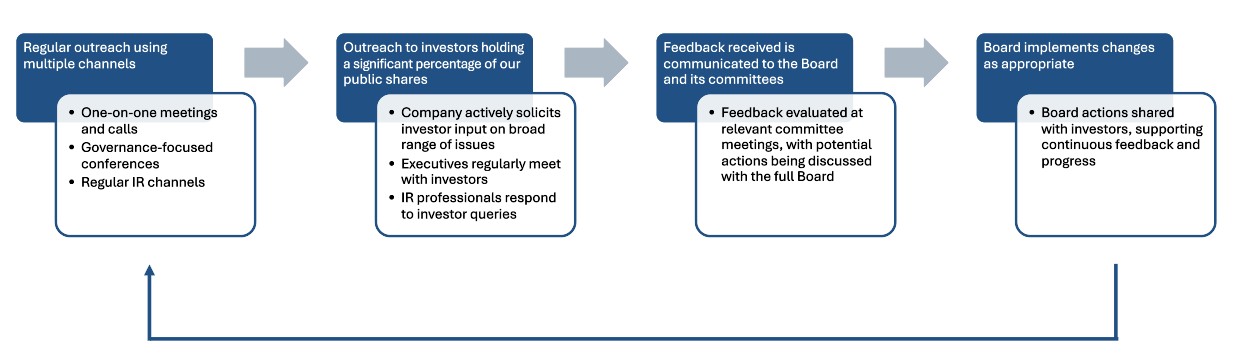
The Nominating and Corporate Governance Committee and our Board are committed to regularly considering the feedback received from our stockholders and other stakeholders during our engagements to determine what further actions, if any, should be taken in the best interest of our company and its stockholders.
We intend to continue our stockholder outreach following the filing of this Proxy Statement with the SEC to seek support for our annual meeting proposals and to solicit additional feedback regarding governance, compensation and other matters of importance to our stockholders. We view this outreach effort as a valuable opportunity to discuss measures that are important to our stockholders. We also intend to continue our stockholder engagement efforts following the Annual Meeting regardless of the vote results on the proposals included herein.
2025 Stockholder Feedback
During the second half of 2025, we solicited feedback from institutional investors holding approximately 35% of our outstanding shares, and received feedback from investors holding approximately 12% of our outstanding shares. Our integrated engagement team included our Chief Financial Officer, our General Counsel, the head of our human resources team, and our investor relations team, and in certain engagements the chair of our Compensation Committee participated. We discussed numerous topics of stockholder interest, including our 2025 “say on pay” vote results, corporate strategy, corporate governance, board skills and leadership, and other issues. Please see below for governance highlights from the feedback received. We discuss compensation-related highlights in “Executive Compensation—Overview of Executive Compensation.”
18
| What We Heard | Our Response | ||||
Corporate Defensive Measures. Stockholders expressed a desire for us to consider certain changes to our corporate defensive measures, including our classified board structure and certain supermajority voting requirements. | •Each year our Nominating and Corporate Governance Committee reviews our governance posture in light of best practices, industry trends, stockholder feedback, and other specific characteristics or circumstances of our company at the time. The committee also considers the prevalence of the corporate defensive measures among companies of similar size and maturity in our industry. •Following this review, the Nominating and Corporate Governance Committee determined that our company and its stockholders are, at this time, best served by maintaining the current classified board structure, stockholder voting standards, and other corporate defensive measures, which are common among our peer group and are designed to enable the Board to ensure that any strategic transaction appropriately values the company and its assets. •The Nominating and Corporate Governance Committee will continue to evaluate these measures on an annual basis. | ||||
Director Skills. Stockholders discussed whether our current Board composition aligns with our strategy. | •The Nomination and Corporate Governance Committee periodically evaluates the Board’s composition, expertise, and experience to ensure that our current directors complement and enhance the Board’s effectiveness. •Our current directors reflect a diverse set of backgrounds and skills, including research and development experience in genomic medicines, strategic and business development experience, and audit and financial expertise. •The Nominating and Corporate Governance Committee believes that the current composition of the Board reflects the experience and expertise appropriate to set and evaluate our strategic objectives and oversee the company. | ||||
Director Nomination Process
The Nominating and Corporate Governance Committee is responsible for identifying individuals qualified to serve as directors, consistent with criteria approved by our Board, and recommending the persons to be nominated for election as directors, except where we are legally required by contract, law or otherwise to provide third parties with the right to nominate directors.
The process followed by the Nominating and Corporate Governance Committee to identify and evaluate director candidates includes requests to Board members and others for recommendations, meetings from time to time to evaluate biographical information and background material relating to potential candidates and interviews of selected candidates by members of the committee and our Board. The qualifications, qualities and skills that the Nominating and Corporate Governance Committee believes must be met by a committee-recommended nominee for a position on our Board are as follows:
•Nominees should have a reputation for integrity, honesty and adherence to high ethical standards.
•Nominees should have demonstrated business acumen, experience and ability to exercise sound judgments in matters that relate to our current and long-term objectives and should be willing and able to contribute positively to our decision-making process.
•Nominees should have a commitment to understand our company and our industry and to regularly attend and participate in meetings of our Board and its committees.
•Nominees should have the interest and ability to understand the sometimes conflicting interests of our various constituencies, which include stockholders, employees, customers, governmental units, creditors and the general public, and to act in the interests of all stockholders.
•Nominees should not have, nor appear to have, a conflict of interest that would impair the nominee’s ability to represent the interests of all of our stockholders and to fulfill the responsibilities of a director.
•Nominees shall not be discriminated against on the basis of race, religion, national origin, sex, sexual orientation, disability or any other basis proscribed by law. Nominees should have broad experience and skills in areas important to the operation of our company.
19
•Nominees should normally be able to serve for at least five years before reaching the age of 75.
The Nominating and Corporate Governance Committee may use a third-party search firm in those situations where particular qualifications are required or where existing contacts are not sufficient to identify an appropriate candidate.
Stockholders may recommend individuals to the Nominating and Corporate Governance Committee for consideration as potential director candidates. Any such proposals should be submitted to our corporate secretary at our principal executive offices and should include appropriate biographical and background material to allow the Nominating and Corporate Governance Committee to properly evaluate the potential director candidate and the number of shares of our stock beneficially owned by the stockholder proposing the candidate. The specific requirements for the information that is required to be provided for such recommendations to be considered are specified in our amended and restated by-laws and must be received by us no later than the date referenced below under the heading “Stockholder Proposals.” Assuming that biographical and background material has been provided on a timely basis, any recommendations received from stockholders will be evaluated in the same manner as potential nominees proposed by the Nominating and Corporate Governance Committee. If our Board determines to nominate a stockholder-recommended candidate and recommends his or her election, then his or her name will be included on our proxy card for the next annual meeting.
Director Independence
Under Nasdaq Listing Rules, a majority of a listed company’s board of directors must be comprised of independent directors within one year of listing. In addition, the Nasdaq Listing Rules require that, subject to specified exceptions, each member of a listed company’s audit, compensation and nominating and corporate governance committees be independent. Audit committee and compensation committee members must also satisfy independence criteria under applicable SEC rules. Under Nasdaq Listing Rules, a director will only qualify as an “independent director” if, in the opinion of the listed company’s board of directors, that person does not have a relationship that would interfere with the exercise of independent judgment in carrying out the responsibilities of a director. In order to be considered independent for purposes of applicable SEC rules, a member of an audit committee of a listed company may not, other than in his or her capacity as a member of the audit committee, the board of directors, or any other board committee, accept, directly or indirectly, any consulting, advisory, or other compensatory fee from the listed company or any of its subsidiaries or otherwise be an affiliated person of the listed company or any of its subsidiaries. In order to be considered independent for purposes of applicable SEC rules, the board must consider, for each member of a compensation committee of a listed company, all factors specifically relevant to determining whether a director has a relationship to such company that is material to that director’s ability to be independent from management in connection with the duties of a compensation committee member, including: the source of compensation of the director, including any consulting advisory or other compensatory fee paid by such company to the director, and whether the director is affiliated with the company or any of its subsidiaries or affiliates.
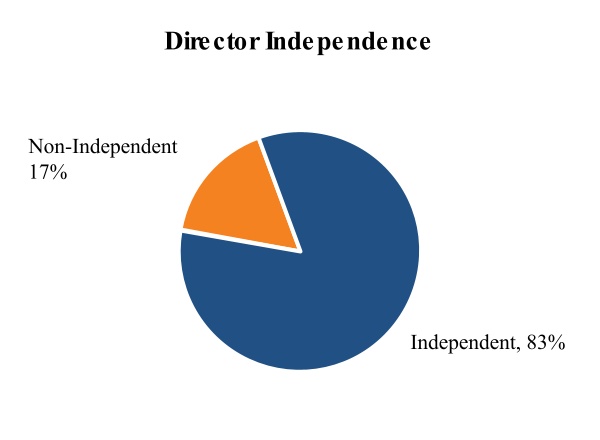
Our Board has reviewed the composition of our Board and its committees and the independence of each director. Based upon information requested from and provided by each director concerning his or her background, employment and affiliations, including family relationships, our Board has determined that each of Drs. Hopfield, Levy, and Scadden, Mr. Hirsch and Ms. Connaughton is an “independent director” as defined under Nasdaq Listing Rules. Our Board has also determined that Mr. Hirsch and Drs. Hopfield and Levy, who comprise the Audit Committee of our Board, and Ms. Connaughton, Dr. Scadden and Mr. Hirsch, who comprise the Compensation Committee, satisfy the independence standards for such committees established by the SEC and the Nasdaq Listing Rules, as applicable. In making such determination, our Board considered the relationships that each such non-employee director has with our company and all other facts and circumstances our Board deemed relevant in determining independence, including the beneficial ownership of our capital stock by each non-employee director.
20
Board Skills & Experience Mix
The following table and charts provide information regarding our nominees for director and our existing directors as of April 20, 2026. We have narrowly tailored and defined these categories, although inclusion in certain categories will in many cases provide experience and expertise covered by other categories.
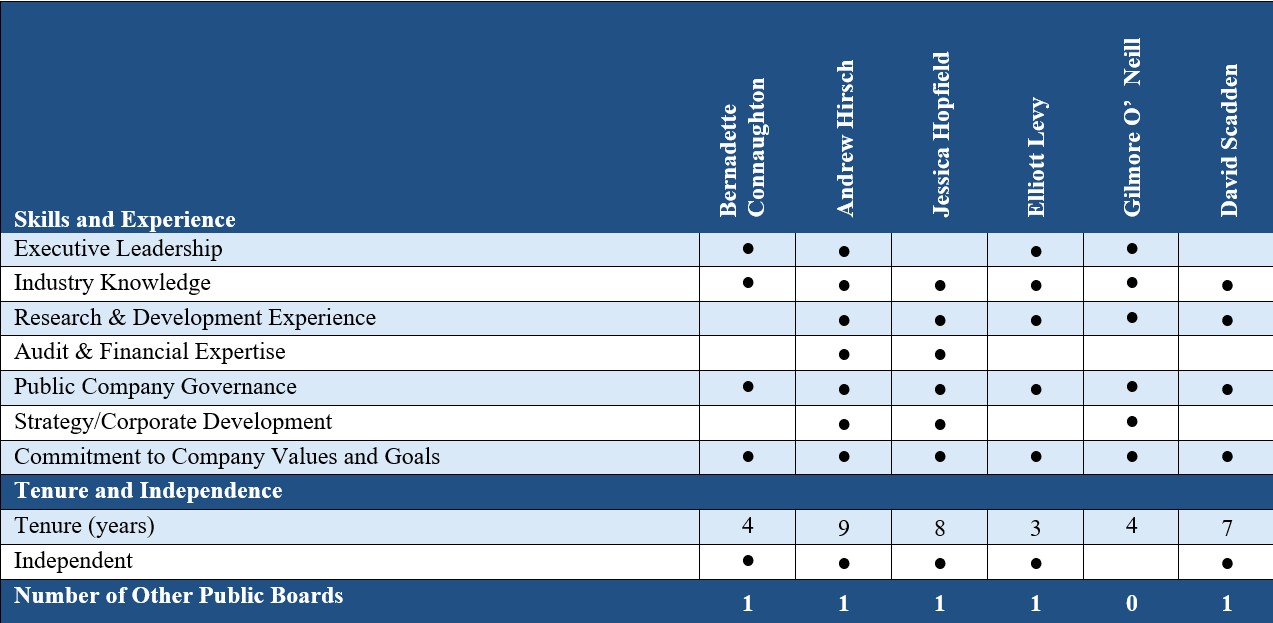
The broad experience and backgrounds of the Board provides a balance of perspectives that contribute to the Board’s effectiveness in overseeing our business and strategy. We believe that our current directors, individually and as a group, have the necessary experience, knowledge and abilities to set our strategic objectives and oversee the company as we implement our strategy.
| Experience, Competencies & Skills | Director Qualifications for Possessing the Skill | Directors with this Skill | ||||||
| Executive Leadership | Experience serving as a public company Chief Executive Officer or in other senior leadership roles hones skills in core management areas - such as strategic planning, financial reporting, compliance, risk management and leadership development. |  | ||||||
| Industry Knowledge | Experience as a senior leader or director in relevant industries such as biotechnology, pharmaceuticals, or medical devices provides a deep understanding of our business strategy and operations. |  | ||||||
| Research & Development Experience | Directors with backgrounds in academia, science and technology, and, in particular, the research and development of genomic medicines, will better enable us to develop a robust pipeline of medicines for people living with serious diseases around the world. |  | ||||||
| Audit & Financial Expertise | Experience in senior finance, capital markets and financial reporting roles enables our directors to effectively monitor and assess our operating and strategic performance and capital allocation approach, and ensure accurate financial reporting and robust controls. |  | ||||||
| Public Company Governance | Public company board experience provides insight into new and alternative practices which informs our commitment to excellence in corporate governance and helps ensure that the Board is functioning as an effective and cohesive oversight body with independent perspectives. | | ||||||
| Strategy/Business Development | Experience in senior strategic and business development roles helps inform our strategy with respect to in-licensing complementary technologies, developing partnerships, and monetizing our intellectual property portfolio. |  | ||||||
| Commitment to Company Values and Goals | Commitment to our company and its values and goals strengthens the contributions of directors to our company and its prospects for success. | | ||||||
21
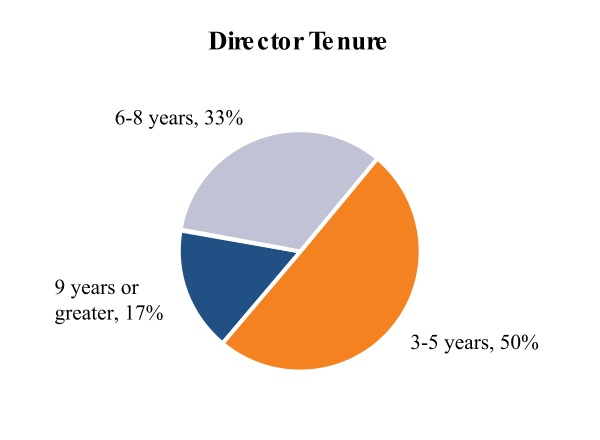
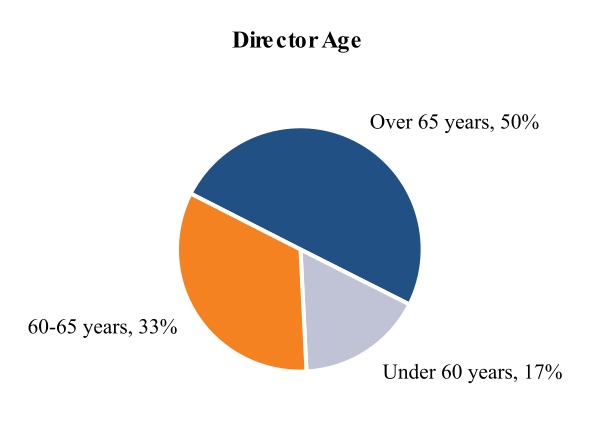
Board Committees
Our Board currently has three standing committees: the Audit Committee, the Compensation Committee, and the Nominating and Corporate Governance Committee and may from time to time form such other committees that the Board deems necessary. Each of the Audit Committee, Compensation Committee, and the Nominating and Corporate Governance Committee operates under a charter, and each such committee reviews its respective charter at least annually. A current copy of the charter for each of the Audit Committee, Compensation Committee, and Nominating and Corporate Governance Committee is posted on the corporate governance section of the “Investors” section on our website, which is located at http://www.editasmedicine.com.
Audit Committee
The members of the Audit Committee are Andrew Hirsch, Jessica Hopfield, and Elliott Levy. Mr. Hirsch is the chair of the Audit Committee. Our Board has determined that Mr. Hirsch is an “audit committee financial expert,” as defined in applicable SEC rules. In making this determination, our Board has considered Mr. Hirsch’s formal education and the nature and scope of his experience as described above. The Audit Committee assists our Board in its oversight of our accounting and financial reporting process and the audits of our consolidated financial statements. The Audit Committee met five times during the year ended December 31, 2025. The Audit Committee’s responsibilities include:
•appointing, approving the compensation of, and assessing the independence of the registered public accounting firm;
•overseeing the work of our independent registered public accounting firm, including through the receipt and consideration of reports from such firm;
•reviewing and discussing with management and our independent registered public accounting firm our annual and quarterly consolidated financial statements and related disclosures;
•monitoring our internal control over financial reporting, disclosure controls and procedures, and code of business conduct and ethics;
22
•discussing, evaluating, and reporting to the Board our major risk exposures, including financial risks, information technology, cybersecurity and data privacy risks, and health information and legal and compliance risks;
•establishing procedures for the receipt and retention of accounting related complaints and concerns;
•meeting independently with our internal auditing staff, our independent registered public accounting firm, and management;
•reviewing and approving or ratifying any related person transactions; and
•preparing the Audit Committee report required by SEC rules.
All audit services to be provided to us and all non-audit services, other than de minimis non-audit services, to be provided to us by our registered public accounting firm must be approved in advance by the Audit Committee.
Organization, Leadership and Compensation Committee
The members of the Compensation Committee are Bernadette Connaughton, Andrew Hirsch, and David Scadden. Ms. Connaughton is the chair of the Compensation Committee. The Compensation Committee assists our Board in the discharge of its responsibilities relating to the compensation of our executive officers and other members of senior management. The Compensation Committee met five times during the year ended December 31, 2025. The Compensation Committee’s responsibilities include:
•reviewing and making recommendations to our Board with respect to the compensation of our Chief Executive Officer;
•reviewing and approving, or making recommendations to our Board with respect to, the compensation of our other executive officers and senior management;
•overseeing the evaluation and leadership development of our senior executives, including reviewing development, retention and succession plans for such senior executives, excluding succession planning for our Chief Executive Officer;
•assessing, monitoring and making recommendations to our Board with respect to our organizational health, leadership development programs and processes designed to attract, motivate, develop and retain employees;
•reviewing and making recommendations to our Board with respect to our incentive compensation and equity-based compensation plans;
•overseeing and administering our equity-based plans;
•reviewing and making recommendations to our Board with respect to director compensation;
•reviewing and discussing with management our “Compensation Discussion and Analysis” disclosure, if applicable;
•preparing the compensation committee report required by SEC rules, if applicable; and
•overseeing the administration and interpretation of our compensation recovery policies.
The Compensation Committee meets regularly in executive session. However, from time to time, various members of management and other employees, as well as outside advisors or consultants, may be invited by the Compensation Committee to make presentations, to provide financial or other background information or advice, or to otherwise participate in Compensation Committee meetings. No officer may participate in, or be present during, any deliberations or determinations of the Compensation Committee regarding the compensation for such officer or any immediate family member of such officer. The charter of the Compensation Committee grants the Compensation Committee full access to all of our books, records, facilities, and personnel, as well as authority to obtain, at our expense, advice and assistance from internal and external legal, accounting, or other advisors and consultants, and other external resources that the Compensation Committee considers necessary or appropriate in the performance of its duties. In particular, the Compensation Committee has the sole authority to retain compensation consultants to assist in its evaluation of executive and director compensation, including the authority to approve the consultant’s reasonable fees and other retention terms.
Historically, the Compensation Committee reviews all compensation components including base salary, bonus, benefits and equity incentives, as well as severance arrangements, change-in-control benefits and other forms of executive officer compensation and provides a recommendation to the Board on the compensation of our Chief Executive Officer. In addition, the Compensation Committee also considers matters related to individual compensation, such as compensation for new executive hires, as well as high-level strategic issues, such as the efficacy of our compensation strategy, potential modifications to that strategy, and new trends, plans, or approaches to compensation, at various meetings throughout the
23
year. The Compensation Committee also makes recommendations to our Board regarding the compensation of non-employee directors and has the authority to administer our equity-based plans.
Under its charter, the Compensation Committee may from time to time delegate authority to subcommittees as it deems appropriate.
Nominating and Corporate Governance Committee
The members of the Nominating and Corporate Governance Committee are Jessica Hopfield and Bernadette Connaughton. Dr. Hopfield is the chair of the Nominating and Corporate Governance Committee. The Nominating and Corporate Governance Committee met four times during the year ended December 31, 2025. The Nominating and Corporate Governance Committee’s responsibilities include:
•identifying individuals qualified to become members of our Board;
•recommending to our Board the persons to be nominated for election as directors and to each of our Board’s committees;
•developing and recommending to our Board corporate governance principles;
•overseeing succession planning for our Chief Executive Officer;
•overseeing periodic evaluations of our Board; and
•generally overseeing significant environmental, social and governance matters applicable to our company.
The Nominating and Corporate Governance Committee oversees an annual self-evaluation process of our Board and its committees, including an assessment of the contributions of individual directors. At the conclusion of this process, the Nominating and Corporate Governance Committee determines what actions, if any, to present to the Board and the other committees to further enhance the performance and effectiveness of the Board, its committees and individual directors. As appropriate, this process results in updates or changes to our practices as well as commitments to continue existing practices that our directors believe contribute positively to the effective functioning of our Board and its committees.
Board and Committee Meetings Attendance
The full Board met 13 times during 2025. During 2025, each member of the Board attended in person or participated in 75% or more of the aggregate of (i) the total number of meetings of the Board (held during the period for which such person has been a director) and (ii) the total number of meetings held by all committees of the Board on which such person served (during the periods that such person served).
Director Attendance at Annual Meeting of Stockholders
Although we do not have a formal policy regarding attendance by members of our Board at our annual meeting of stockholders, we encourage all of our directors to attend. All members of our Board, other than Dr. Scadden, attended our 2025 annual meeting of stockholders.
Code of Business Conduct and Ethics
We have adopted a written code of business conduct and ethics that applies to our directors, officers, and employees, including our principal executive officer, principal financial officer, principal accounting officer or controller, or persons performing similar functions. A copy of the code is posted under the heading “Corporate Governance” on the Investors & Media section of our website, which is located at http://www.editasmedicine.com. If we make any substantive amendments to, or grant any waivers from, the code of business conduct and ethics for any officer or director, we will disclose the nature of such amendment or waiver on our website or in a current report on Form 8-K.
Insider Trading Policy
24
Anti-Hedging and Pledging Policy
Our insider trading policy expressly prohibits all of our employees, including our named executive officers, as well as our directors, family members and controlled entities from engaging in speculative transactions in our securities, including short sales, puts/calls, purchases of financial instruments that are designed to hedge or offset any decrease in the market value of our securities, and margin accounts or pledges.
Corporate Governance Guidelines
Our Board has adopted corporate governance guidelines to assist in the exercise of its duties and responsibilities and to serve the best interests of our company and our stockholders. The guidelines provide that:
•our Board’s principal responsibility is to oversee the management of our company;
•except as required by Nasdaq rules, a majority of the members of our Board must be independent directors;
•the independent directors meet in executive session at least twice a year;
•directors have full and free access to management and, as necessary, independent advisors; and
•the Nominating and Corporate Governance Committee will oversee periodic self-evaluations of the Board to determine whether it and its committees are functioning effectively.
A copy of the corporate governance guidelines is posted under the heading “Corporate Governance” on the Investors & Media section of our website, which is located at http://www.editasmedicine.com.
Board Refreshment and Succession Planning
The Nominating and Corporate Governance Committee is responsible for ensuring that our Board is comprised of highly qualified directors that have broad experience and skills in areas important to our operation, as well as diversity of age, gender, race, national origin, ethnicity, sexual orientation, and education, to ensure the creation of long-term stockholder value. The Nominating and Corporate Governance Committee seeks to ensure that our Board as a whole possesses the mix of skills and experiences to provide effective oversight and guidance to management to execute on our long-term strategy. The Nominating and Corporate Governance Committee’s refreshment philosophy prioritizes skills that it considers important and desirable based on our current needs and business priorities. For this reason, our current Board consists of members with a variety of skills, including scientific, financial, business development, and management, gained from their professional backgrounds and their service on other boards.
The Nominating and Corporate Governance Committee believes it is desirable to maintain a mix of longer-tenured, experienced directors who have developed enhanced knowledge and understanding of, and valuable insight into, our company and operations and newer directors with fresh perspectives. Of our five independent directors, two (Dr. Levy and Ms. Connaughton) have joined the Board since the beginning of 2021, with our most recent addition being Dr. Levy in April 2023. To ensure a robust approach to director suitability, evaluation, and refreshment, our corporate governance guidelines provide refreshment mechanisms that include the following:
•a formal annual Board and committee self-evaluation, as discussed further below;
•a requirement to offer to tender resignation upon a material change in principal employment;
•a policy that limits non-executive director service to no more than four public boards (including Editas) and requires notification prior to appointment to another public company board; and
•a requirement that any director who reaches the age of 75 while serving as a director must retire from the Board effective at the end of his or her term.
Board and Committee Evaluation Process
The self-evaluation process is an effective tool in ensuring sound corporate governance practices, which are important to the success of our business and in advancing stockholder interests. The Nominating and Corporate Governance Committee oversees an annual self-evaluation by the Board and each of its committees of their performance to ensure effective functioning and to identify opportunities for improvement. This annual evaluation includes an assessment of the individual contributions of each director.
25
As part of the self-evaluation process, directors complete a comprehensive questionnaire, which asks them to consider various topics related to Board and committee composition, structure, effectiveness, and responsibilities, as well as satisfaction with the schedule, materials, and discussion topics. From time to time, the Nominating and Corporate Governance Committee may include as part of the process interviews with directors, conducted either by the committee chair or by third parties. Each committee, including the Board as a whole, then reviews and assesses the responses in executive session, with each committee presenting its findings and recommendations to the Board. The results of the evaluations are then discussed by the Board, with a view toward taking action to address any issues presented. Results requiring additional consideration are addressed at subsequent Board and committee meetings, where appropriate. While this formal self-evaluation is conducted on an annual basis, directors share perspectives, feedback, and suggestions year-round, both with other directors and with management. The self-evaluation process provides valuable insight regarding areas of effectiveness and opportunities for improvement.

Director Commitments Policy
Our Nominating and Corporate Governance Committee reviews each director’s external time commitments not less than quarterly and, as required by our corporate governance guidelines, takes into account the nature of, including any public company board leadership positions, and time involved in a director’s service on other boards in evaluating the suitability of individual directors and making recommendations to the Board. In addition, our corporate governance guidelines provide that existing directors should advise the Board chair and the chair of the Nominating and Corporate Governance Committee in advance of accepting an invitation to serve on another public company board. The Nominating and Corporate Governance Committee reviews such requests and has the discretion as to whether to approve or disapprove such directorship.
Our corporate governance guidelines include a formal policy limiting the number of director external commitments, requiring that:
•no director who serves as an executive officer of any public company (including Editas) should serve on the boards of more than two public companies (including Editas);
•no non-employee director should serve on the boards of more than four public companies (including Editas); and
•no director who serves as non-executive Chair of the Board or as lead independent director should serve on the boards of more than four public companies (including Editas),
in each case unless the Nominating and Corporate Governance Committee determines that such service would not impair the ability of such director to effectively serve on the Board. As of the date of this Proxy Statement, all directors are in compliance with this policy.
Board Leadership Structure and Board’s Role in Risk Oversight
Board Leadership Structure
Our corporate governance guidelines provide the Board with flexibility to select the leadership structure that the Board believes is most appropriate given the specific characteristics or circumstances of our company at the time. The Board periodically considers its structure and leadership, in particular whether the roles of Chief Executive Officer and chair of the Board should be combined or separated. At this time, the roles of Chief Executive Officer and chair of the Board are separate. We believe that, generally, separating the chief executive and chair roles is a strong governance practice and contributes to the Board’s independence from management, while allowing the Chief Executive Officer to focus primarily
26
on our business, strategy and operations. The Board evaluates our Board leadership structure from time to time and may recommend or implement further alterations of this structure in the future.
In December 2024, our Board appointed Jessica Hopfield, an independent director under applicable Nasdaq rules, as chair of the Board. Dr. Hopfield previously served as our lead independent director from February 2021 to June 2023. She has significant executive and consulting experience in the healthcare, pharmaceutical, and medical device industries, as well as strong leadership experience as a director on other public company boards of directors, including as lead independent director on the board of directors of Insulet Corporation from August 2016 until January 2019. As a longstanding member of the Board, she also has an in-depth understanding of our business strategies and day-to-day operations, which makes her well suited to set the agenda and lead the discussions at Board meetings as the chair. Dr. Hopfield’s duties as chair include determining the frequency and length of Board meetings, recommending when special meetings of the Board should be held, preparing or approving the agenda for each Board meeting, chairing meetings of our independent directors, meeting with any director who is not adequately performing his or her duties as a member of the Board or any committee of the Board, facilitating communications between management and the Board, and assisting with other corporate governance matters. In addition, our Chief Executive Officer, Dr. O’Neill, also serves on our Board. The Board believes that Dr. O’Neill’s membership as a director provides the Board with an in-depth understanding of our business operations because of his extensive experience and knowledge of the day-to-day management of all aspects of our operations. This also facilitates communications between the Board and management by ensuring a regular flow of information, thereby enhancing the Board’s ability to make informed decisions on critical issues facing our company.
Of the six directors on our Board, five directors are independent under applicable Nasdaq corporate governance rules. The Board believes that this establishes a strong independent board that provides effective oversight of the company. Moreover, in addition to feedback provided during the course of Board meetings, the independent directors conduct regular executive sessions without the presence of Dr. O’Neill or any other members of management.
Risk Oversight
Risk is inherent with every business and how well a business manages risk can ultimately determine its success. We face a number of risks, including those described under “Risk Factors” in our 2025 Annual Report and in the other reports we file with the SEC from time to time. Our Board is actively involved in oversight of risks that could affect us. This oversight is conducted primarily by our full Board, which has responsibility for general oversight of risks. Our Board oversees our risk management processes directly and through its committees. Our management is responsible for risk management on a day-to-day basis and our Board and its committees oversee the risk management activities of management. Our Board satisfies this responsibility through full reports by each committee chair regarding the committee’s considerations and actions, as well as through regular reports directly from officers responsible for oversight of particular risks within our company, including those related to any potential security breaches. The Audit Committee oversees risk management activities related to financial controls, legal and compliance risks and cybersecurity risks. As part of this oversight, the Audit Committee receives regular reports from management on such risks at its regularly scheduled meetings and the actions management has taken to limit, monitor or control such exposures. The Audit Committee also meets with members of our information technology department, including our Head of Information Security, not less than twice per year to assess information security risks (including cybersecurity risks) and to evaluate the status of our cybersecurity efforts, which include a broad range of tools and training initiatives that are designed to work together to protect the data and systems used in our business. The Audit Committee also meets privately with representatives from our independent registered public accounting firm as part of its oversight of our risk management. The Compensation Committee oversees risk management activities relating to our compensation policies and practices, our organizational health and succession planning for the members of our senior management. The Nominating and Corporate Governance Committee oversees risk management activities relating to our Board’s composition and succession planning for our Chief Executive Officer. In addition, members of our senior management team attend our quarterly Board meetings and are available to address any questions or concerns raised by the Board on risk management and any other matters. Our Board believes that full and open communication between management and the Board is essential for effective risk management and oversight.
Commitment to Corporate Responsibility
At Editas, our mission is to translate the power and potential of the clustered regularly interspaced short palindromic repeats (“CRISPR”)/Cas12a and CRISPR/Cas9 genome editing systems into a robust pipeline of treatments for people living with serious diseases around the world. We believe that delivering on this mission over the long term requires an understanding of the importance of corporate citizenship, including environmental, social and governance considerations, and the meaningful difference it can have on our patients, our employees and the communities in which we live and work.
27
Our Patients
For us, the patient is—and must be—at the center of everything we do. We are acutely aware that gene editing represents a fast-moving, potentially disruptive technology that evokes both excitement and curiosity. We believe it is critical to be transparent about our science and engage responsibly with the patient communities we seek to help. In doing so, we commit to:
Engage regularly—seek out opportunities to learn from the communities we aim to create a treatment option for, and continue to bring their voices into decision making and drug development planning.
Listen actively—health and treatment is deeply personal, and there are similarities and differences across diseases, and among individuals affected by the same disease. It is critical that we listen and understand diverse perspectives.
Engage authentically—we are optimistic about the promise of gene editing, yet there is still much to be learned. Through transparent communication about our company and our approach to developing medicines, we hope to ensure the expectations we set are realistic.
As part of our commitment to our patient community, we regularly partner with leading patient groups and other organizations that promote scientific and medical advancements, patient care, and new payment models allowing patients to access life-saving therapies. Our medical affairs and patient advocacy team help support clinical communications and proactively engage with the patient community.
Further, we recognize that inequalities in our current healthcare system contribute to gaps in health insurance coverage, uneven access to services, and poorer health outcomes among certain populations. As we continue to evolve, our ability to address these health disparities grows as well. Patients are the reason our company exists, and as we execute on our mission to translate the promise of gene editing into a broad class of differentiated, transformational medicines for previously untreatable diseases, we also endeavor to expand patient access and thereby help ameliorate the inequalities facing patients that have less access to healthcare.
Our Employees
Diversity and Inclusion
We strongly believe that our greatest strength comes from the people who make up our team. Each employee brings diverse perspectives, backgrounds, and thinking styles, and when we champion inclusion, we cultivate a culture where every individual feels valued and can thrive. Our commitment to embracing and celebrating our differences fuels our drive to excel in scientific innovation, allowing us to harness the power of gene editing to develop groundbreaking and life-changing therapies for people living with serious diseases with the greatest unmet needs.
We have cultivated a diverse and inclusive workforce, including in our senior management team, to ensure an environment where employees feel empowered to achieve their fullest potential. As of December 31, 2025, 48% of our full-time employees were women and 37% of our senior management (director level and above) were women. As of December 31, 2025, 44% of our full-time employees identify as racially/ethnically diverse and 37% of our senior management identify as racially/ethnically diverse.
At Editas, we seek to translate the power and potential of CRISPR gene editing into a robust pipeline of medicines for people living with serious diseases around the world. We recognize that our success is driven by our courageous, collaborative, and passionate employees, who celebrate diversity and together foster a workplace that values inclusivity, where all voices are heard and respected. We seek to be an employer of choice that empowers our employees to drive innovation to develop transformative medicines for people living with serious diseases around the world.
Recruitment, Retention and Development
Successful execution of our strategy is dependent on attracting, retaining and motivating a diverse team of highly skilled employees at all levels. We believe a key component of recruiting, retaining and motivating our employees is our total compensation package. For this reason, we provide employees with competitive compensation, including market-competitive salary and equity awards, along with competitive benefits packages, including medical, dental, vision and life insurance, flexible spending accounts, short- and long-term disability and matching contributions to a 401(k) tax-deferred savings plan. We also provide annual cash incentive bonus opportunities that are tied to both company performance and individual performance to foster a pay-for-performance culture. We regularly benchmark these total rewards against our industry peers to ensure we remain competitive and attractive to potential new hires.
28
We believe that continued learning and development, training and other resources are also an essential part of retaining our employees and creating a culture of learning and leadership. We encourage our employees to participate and take advantage of a variety of learning and development resources, including online skills courses, professional development events, and external training programs based on individual needs. We have also implemented formal coaching and mentoring programs, which enable employees to connect with, and learn and develop from, individuals across our company.
Communication and Engagement
We recognize that our employees perform best when they know how their work contributes to our overall strategy. To achieve this, we emphasize open and direct communication through the use of a variety of channels, including quarterly all-company business updates from the senior management team, fireside chats with new members of the board of directors and our executive management team, open forums and company-wide written communications, and postings on our company intranet.
In addition, we periodically conduct employee surveys to gauge employee engagement and solicit feedback, and enhance our understanding of the views of our employees, work environment and culture. The results from engagement surveys are used to implement programs and processes designed to enhance employee engagement and improve the employee experience.
Health, Wellness and Safety
Employee safety and well-being is of paramount importance to us. In addition to traditional benefits such as healthcare, flexible time off, paid parental leave, and retirement benefits, we offer a variety of benefits and resources to support employees’ physical and mental health, including a lifestyle spending allowance that employees may allocate to certain wellness programs and a third-party employee assistance program, which help us both attract talent and help to realize a healthier workforce.
Our Community
Community Involvement
Through both corporate initiatives and individual contributions of our employees, we seek to make a difference in our communities. These initiatives promote employee volunteerism to serve and fundraise for a wide variety of community causes, including toy drives for children in need, collections for individuals facing clothing or hygiene insecurity, and educational initiatives.
Environment
We are a preclinical biotechnology company, and as such currently have a small ecological footprint. However, we recognize the importance of limiting our environmental impact and operating our business in a sustainable manner. We are committed to reducing, reusing and recycling where possible, and utilizing energy efficient facilities and equipment to lower our energy use within our office areas and laboratories. To reduce pollution and avoid traffic congestion, we provide transportation benefits to our employees to encourage the use of non-automobile-based transportation, such as public transportation, cycling, and walking. In addition, we have on-site recycling programs in all our locations.
Further, we seek to use facilities and electrical equipment that are specifically designed for optimal performance and sustainability. We believe lower energy usage is not only beneficial to our stockholders, but the environment as well. Our state-of-the-art wastewater control system also helps improve energy efficiency through modern fixtures, mechanical and laboratory equipment, and water recycling and monitoring systems.
Communication with Our Directors
Any interested party with concerns about our company may report such concerns to our Board by submitting a written communication to the attention of our corporate secretary or the chair of the Board at the following address:
c/o Editas Medicine, Inc.
11 Hurley Street
Cambridge, Massachusetts 02141
United States
29
You may submit your concern anonymously or confidentially by mail. You may also indicate whether you are a stockholder, supplier, or other interested party.
Communications will be forwarded to all directors if they relate to important substantive matters and include suggestions or comments that the chair of the Board (if one is appointed and is an independent director), the lead independent director (if one is appointed) or otherwise the chair of the Nominating and Corporate Governance Committee, subject to the advice and assistance of counsel, consider to be important for the directors to know. In general, communications relating to corporate governance and corporate strategy are more likely to be forwarded than communications relating to ordinary business affairs, personal grievances and matters as to which we receive repetitive or duplicative communications.
30
EXECUTIVE COMPENSATION
Overview of Executive Compensation
This section discusses the principles underlying our policies and decisions with respect to all material elements of the compensation of our named executive officers.
Our named executive officers for the fiscal year ended December 31, 2025, were:
•Gilmore O’Neill, M.B., M.M.Sc., our President and Chief Executive Officer;
•Linda C. Burkly, Ph.D., our Executive Vice President and Chief Scientific Officer; and
•Amy Parison, who was appointed our Senior Vice President and Chief Financial Officer on March 28, 2025.
| Editas Background and Select Business Highlights | ||
We are a pioneering gene editing company dedicated to developing potentially transformative genomic medicines to treat a broad range of serious diseases. The promise of genomic medicines is supported by the advancing knowledge of the human genome and by harnessing the progress in technologies for cell therapy, gene therapy, and, most recently, gene editing. We believe this progress sets the stage for us to create medicines with the potential to have a durable benefit for patients. Our core capability in gene editing uses the technology known as CRISPR to allow us to create molecules that efficiently and specifically edit DNA. Our mission is to translate the promise of gene editing into a broad class of differentiated, transformational medicines for previously untreatable diseases.
We believe 2025 was a year of strong performance for Editas. In December 2024, following scientific breakthroughs by our team, we accelerated our strategy to become a leader in in vivo gene editing by transitioning to a fully in vivo focused preclinical company and announcing our intent of achieving in vivo human proof-of-concept within approximately two years. We ended 2025 having made considerable progress on this strategy, while also extending our cash runway through the use of our at-the-market offering facility and financial discipline. Through these efforts, we believe we are now well positioned to advance the first of our potentially transformative medicines, EDIT-401, into the clinic and closer to patients in waiting.
Below are select business highlights for 2025.
| Cardiovascular | •We announced the nomination of our lead in vivo development candidate, EDIT-401. EDIT-401, an experimental, potential best-in-class, one-time therapy designed to treat hyperlipidemia through upregulation of the LDL receptor. In preclinical studies in non-human primates, EDIT-401 has achieved LDL-C reductions exceeding 90%. | ||||
| Hemoglobinopathies | •We progressed our hemoglobinopathies program. Leveraging our differentiated approach from our former reni-cel program, in January 2025, we announced in vivo preclinical proof-of-concept data of editing HSC in non-human primates, a key step in developing an in vivo treatment for sickle cell disease and transfusion-dependent beta thalassemia, and continued to optimize candidates for our HSC program. | ||||
| Other cells and tissues | •We advanced our “plug ‘n play” LNP platform. This platform is designed to enable targeted delivery of in vivo gene editing medicines to multiple cells and tissues. In the liver, using this LNP platform enables us to develop new therapies by only reprogramming guide RNAs for specific liver targets. For extrahepatic delivery, our LNP platform enables us to target multiple tissues through the substitution of different targeting ligands conjugated to the LNP. | ||||
31
| Compensation Highlights | ||
Highlighted below are the key compensation actions the Board and the Compensation Committee took in 2025 and early 2026, reflecting our performance, organizational needs, and long-term business strategy.
•Annual Performance-based Cash Bonus Program: Our annual performance-based cash bonus program provides for independent weighting of corporate and individual achievement to calculate the bonus payout for our employees, including our named executive officers other than our Chief Executive Officer, whose bonus is based solely on corporate achievement. For our named executive officers, corporate and individual performance is weighted as follows: (i)Chief Executive Officer: 100% based on corporate performance (ii)other named executive officers: 80% based on corporate performance, 20% based on individual performance. In February 2026, the Compensation Committee reviewed our performance against our corporate objectives, as well as each named executive officer’s performance against their individual objectives, where applicable. Following this review, the Compensation Committee recommended, and our Board approved, that our corporate objectives were achieved at 91% of target. Taking into account the achievement of our corporate objectives and review of individual performance, our named executive officers received an average payout under the annual performance-based cash bonus program of 91% of target. | ||
•Transition to All Options in Executive Equity Award Program: In connection with our acceleration from a clinical-stage company with both in vivo and ex vivo programs to a fully in vivo focused preclinical company in December 2024, we updated our peer group to align with our new preclinical status and new corporate size and strategy. At that time, we reevaluated the structure of our equity incentive program to ensure alignment with this updated peer group and our new company profile and strategy. In February 2025, our Compensation Committee determined that all employees would receive only time-based vesting stock options rather than a mix of time-based vesting RSUs and time-based vesting stock options, as had been awarded to employees in the past. For our officers, including the named executive officers, the Compensation Committee also determined to no longer award PSUs, as it had done in previous years. The Compensation Committee determined that this transition in the type of equity awards made was appropriate in order to create momentum to drive long-term stockholder value and simplify the equity compensation program for our employees. This transition also reflects the guidance of the Compensation Committee’s independent compensation consultant that RSUs and PSUs are less common among preclinical biotechnology companies, including other companies in our updated peer group. The Compensation Committee believes that options are performance-based equity awards, particularly with our typical four-year vesting period, since the recipient recognizes value only if the company achieves objectives that result in recognized stockholder value and our stock price appreciates over time. | ||
Say-on-Pay Vote Results
At our 2025 annual meeting of stockholders, we conducted a non-binding advisory vote on the compensation of our named executive officers as disclosed in our 2025 proxy statement, commonly referred to as a “say-on-pay” vote. Approximately 61% of the votes cast on this proposal approved of the compensation paid to the named executive officers.
Our Compensation Committee and Board take the “say-on-pay” voting results into account in determining the compensation of our named executive officers and were disappointed with the results in 2025. Following discussion with the Compensation Committee, our management agreed that it would engage with our principal stockholders to discuss and better understand the reasons for the stockholders’ votes. We solicited feedback from our largest stockholders and were able to engage with the responding stockholders. Based on feedback from these stockholders as well as certain proxy advisor firms, we understand that concerns with our executive compensation program relate primarily to a perceived pay-for-performance misalignment and the absence of quantitative metrics in our compensation strategy.
32
Below is a summary of feedback from our stockholders and certain proxy advisory firms:
What We Heard | Our Response | ||||
Use of Quantitative Metrics. Some stockholders noted a preference for more quantitative metrics as part of our annual cash bonus program. | •As a pre-commercial company, identifying quantitative metrics that support long-term stockholder value creation is challenging. However, the Compensation Committee and management strive to make our bonus program metrics objective in order to enable a clear measurement framework at year end. •For this reason, annually, the Compensation Committee sets challenging research and development, clinical, and operational qualitative and quantitative goals to drive management performance and promote value creation. •For example, our 2025 annual performance-based cash program included as milestone goals the declaration of an in vivo gene editing development candidate, creation of an integrated development plan for regulatory submission to commence a clinical trial, and delivery of drug product to enable preclinical studies to support that regulatory submission. | ||||
Pay-for-Performance Misalignment. Certain stockholders and a proxy advisory firm noted a pay-for-performance misalignment, particularly noting that the majority of equity awards remain time-based. | •In connection with our acceleration to a fully in vivo focused preclinical company in December 2024, the Compensation Committee reevaluated the structure of our equity incentive program to ensure alignment with our updated 2025 peer group. •This reevaluation indicated that the use of performance-based RSUs was uncommon and that peers generally granted time-based options and RSUs. •The Compensation Committee determined to transition all employee equity awards to time-based options in order to create momentum to drive long-term stockholder value and simplify the program for our employees. •In furtherance of our pay-for-performance culture, our employees now only see value in their equity awards if the company creates recognized stockholder value and the price of our stock appreciates over time. Further, the four-year vesting period used for our new hire and annual equity awards promotes long-term employee retention. •Further demonstrating our pay-for-performance culture, our Board approved that our corporate objectives were achieved at 91% of target and total compensation to our Chief Executive Officer declined compared to his 2024 total compensation. | ||||
Additional Disclosure. Certain stockholders requested that we provide additional disclosure regarding our annual cash bonus program. | •We have disclosed under “—Executive Compensation Elements & Decisions” the objectives, including specified targets and achievements, taking into account the potential competitive harm that could result by disclosing sensitive achievements or strategic objectives. | ||||
Our Compensation Committee and Board will continue to consider stockholder input and proactively monitor our executive compensation program to ensure it aligns the interests of our named executive officers with the interests of our stockholders and adequately addresses any stockholder concerns that may be expressed.
Compensation Objectives and Philosophy
Our compensation programs are designed to attract and retain qualified and talented executives, motivate such executives to achieve our business goals and reward them for short- and long-term performance. We strive for clarity and transparency in communicating our compensation programs and believe this is an essential component of employee engagement, equity and inclusion. To achieve its objectives, the Compensation Committee structures our executives’ compensation with a number of key elements, each with its own focus and purpose. We intend for total compensation, which we define as base salary, performance-based cash compensation, equity compensation and benefits, to be
33
competitive in the biopharmaceutical marketplace in which we compete for talent in order to help us achieve our short- and long-term financial and operational goals.
| Element of Compensation | Purpose | Features | ||||||
| Base Salary | Attract, retain and reward talented executives needed to drive our business. | Fixed component of compensation to provide financial stability, based on responsibilities, experience, internal equity, performance and peer company data. | ||||||
| Annual Performance-based Cash Bonuses | Motivate the achievement of business goals that the Compensation Committee and the Board believe are important to the overall success of the business and will enhance stockholder value over time. | Variable component of compensation tied to the achievement of pre-determined corporate performance goals and, for executive officers other than our Chief Executive Officer, on individual achievement. | ||||||
| Annual Equity Incentives | Assist in retaining our executive officers and aligning their interests with those of our stockholders by allowing them to participate in the longer-term success of our company as reflected in the appreciation of our stock price. | Variable component of compensation in the form of stock options typically subject to multi-year vesting based on continued service, the value of which is tied to the performance of our common stock price. | ||||||
The Compensation Committee works closely with Pearl Meyer & Partners, LLC (“Pearl Meyer”), and independent compensation consultant, throughout the year to ensure that our compensation program remains competitive and within market. One of the services provided by Pearl Meyer to the Compensation Committee is the identification of a market framework (including a peer group of companies) for formal compensation benchmarking purposes. Peer group benchmarking is one of the key factors considered by the Compensation Committee in setting named executive officer compensation levels and making other compensation decisions. While starting base salaries, new hire equity grants and our benefit programs are fixed, merit salary increases, actual cash incentive awards and annual equity grants are based on performance against strategic and operational goals.
Commitment to Pay-for-Performance
The Compensation Committee believes that the total compensation package provided to our named executive officers, which combines both short- and long-term incentives including equity components that are at-risk,
•is competitive without being excessive,
•is at an appropriate level to assure the retention and motivation of highly skilled and experienced leadership,
•is attractive to any additional talent that might be needed in a rapidly changing competitive landscape,
•avoids creating incentives for inappropriate risk-taking by the named executive officers that might be in their own self-interests, but might not necessarily be in the best short- and long-term interests of our stockholders, and
•provides the appropriate incentives to our executives to create long-term organizational and stockholder value.
In establishing the levels and components of compensation for the named executive officers, including our Chief Executive Officer, the Compensation Committee considers a number of factors, including analyses of compensation of peers and other companies in the biopharmaceutical industry, analyses of reports from Pearl Meyer, the satisfaction of (or failure to satisfy) previously-developed performance measurements for the named executive officers and our company, and the value and size of the total vested and unvested equity grants maintained by the named executive officers.
The Compensation Committee retains the authority and flexibility to vary the compensation of any individual named executive officer from the targeted pay framework, based on the unique responsibilities and requirements of his or her position, his or her experience and qualifications, internal parity relative to similar positions within our company, and individual or company performance relative to performance goals and our selected peer group to ensure appropriate pay-for-performance alignment. While we do not have a formal or informal policy for allocating between long-term and short-term compensation, between cash and non-cash compensation or among different forms of non-cash compensation, historically, a majority of the compensation for our named executive officers is long-term compensation, balanced with sufficient short-term incentives to encourage consistently strong performance.
As shown in the following charts, our compensation program is highly performance-based, with approximately 73% of our Chief Executive Officer’s and, on average, 54% of our other named executive officers’ target compensation being variable, either because it was subject to performance goals, the fluctuations of our stock price, or both.
34
The charts below illustrate the target 2025 pay mix (excluding benefits) for Gilmore O’Neill, our Chief Executive Officer, and for our other named executive officers. Please see “Executive Compensation—2025 Summary Compensation Table” for amounts actually earned by each of them.
________________________
(1)Ms. Parison’s initial annual base salary for 2025 was $340,000 but was increased to $415,000 in connection with her promotion in March 2025 to Chief Financial Officer. For purposes of this chart, her annual base salary following promotion has been annualized.
Executive Compensation Program Best Practices
Our Compensation Committee believes that a strong foundation for our compensation program is necessary to execute our executive compensation philosophy effectively. The following best practices serve as the foundation for our executive compensation program:
| What We Do | What We Don’t Do | ||||||||||
| ü | Maintain and evaluate annually an industry-specific peer group for benchmarking pay |  | No employment agreements that guarantee a certain compensation level or employment term | ||||||||
| ü | Review annually our compensation strategy to ensure target pay is based on market norms |  | No guaranteed annual salary increases or guaranteed bonuses | ||||||||
| ü | Balance short-and long-term incentives (through annual cash bonuses and equity awards) | | No single-trigger vesting in connection with a change-in-control for equity awards | ||||||||
| ü | Maintain a compensation recovery or “clawback” policy | | No excessive executive perquisites or personal benefits | ||||||||
| ü | Use multiple performance measures to determine incentive payouts | | No hedging or pledging or speculative transaction in our securities | ||||||||
| ü | Engage independent compensation consultant | | No re-pricing of equity awards without stockholder approval | ||||||||
| No excise tax gross-ups | ||||||||||
Executive Compensation Process
Role of our Compensation Committee. The Compensation Committee is responsible for, among other things, reviewing and approving, or recommending for approval by our Board, the compensation of our executive officers and our senior management, including salary, bonus and incentive compensation levels, equity compensation (including awards to induce employment), severance arrangements, change-in-control benefits and other forms of executive officer compensation. A full description of the Compensation Committee’s role and responsibilities is in the Compensation Committee’s charter, which is available on our website.
Role of Management. As a part of determining named executive officer performance and compensation, the Compensation Committee receives recommendations from our Chief Executive Officer (except with respect to his or her own compensation and performance). Our Chief Executive Officer’s performance and compensation is approved by our Board based upon the recommendation of the Compensation Committee. The evaluation of each of our named executive officers is based on our overall corporate performance against annual goals that are approved by our Board at the beginning of each year and, except with respect to our Chief Executive Officer whose evaluation is based solely on corporate performance, individual performance against pre-established annual goals, as discussed in more detail below. At the
35
invitation of the Compensation Committee, certain members of our senior management also participate in Compensation Committee meetings to share their perspective and relevant information on topics that the Compensation Committee is discussing.
Role of the Compensation Committee’s Independent Compensation Consultant. The Compensation Committee has the sole authority to retain, at our expense, one or more third-party compensation consultants to assist the committee in performing its responsibilities. The Compensation Committee may terminate the services of the consultant if the Compensation Committee deems it appropriate. The Compensation Committee utilized the services of Pearl Meyer to assist it in fulfilling its responsibilities in 2025 and 2026. Pearl Meyer was retained exclusively by the Compensation Committee and has not been retained by management to perform any work for our company other than projects performed at the direction of the Compensation Committee. Pearl Meyer provided analysis and recommendations, where applicable, regarding:
•trends and emerging topics with respect to executive compensation;
•peer group selection for executive compensation benchmarking;
•compensation practices of the selected peer group;
•compensation philosophy and programs, including risk assessment, for executives; and
•stock utilization and other relevant metrics.
Pearl Meyer advised the Compensation Committee on all the principal aspects of executive compensation, including executive new hire and promotion compensation arrangements. Pearl Meyer consultants attended meetings of the Compensation Committee, including executive sessions in which executive compensation issues are discussed, when requested to do so. Pearl Meyer reported to the Compensation Committee and not to management, although it met with management for purposes of gathering information for its analyses and recommendations. The Compensation Committee annually evaluates its engagement of compensation consultants, and selected Pearl Meyer to advise with respect to compensation matters based on Pearl Meyer’s industry experience and reputation, which the Compensation Committee concluded gave Pearl Meyer useful context and knowledge to advise it. The Compensation Committee has assessed the independence of Pearl Meyer pursuant to SEC and Nasdaq rules and concluded that no conflict of interest exists that would prevent Pearl Meyer from independently advising the Compensation Committee.
Defining and Comparing Compensation Benchmarks. The Compensation Committee benchmarks our executive compensation against a peer group of companies to determine competitiveness and market trends. The Compensation Committee reviews the companies in our peer group annually, reviews Pearl Meyer’s recommendations regarding which companies should be included in the peer group and makes adjustments as necessary to ensure the peer group continues to properly reflect the market in which we compete for talented executives. The Compensation Committee also annually reviews the executive pay practices of other similarly situated companies as reported by Pearl Meyer through industry surveys and proxy analysis. These surveys are specific to the biopharmaceutical and biotechnology sector. The Compensation Committee requests customized reports of these surveys so that the compensation data reflect the practices of companies that are like us. The Compensation Committee considers this information when making determinations or recommendations for each element of compensation for our named executive officers.
In developing the peer group of companies to inform 2025 compensation decisions, our Compensation Committee, with the assistance of Pearl Meyer, established a peer group of 20 publicly traded, national and regional companies in the biopharmaceutical industry that was selected based on two categories of companies:
•preclinical or early clinical stage gene editing, gene therapy, cell therapy or rare/genetic disease companies; and
•Massachusetts-based biotechnology or biopharmaceutical preclinical or early clinical stage companies that we believe we compete with for executive talent.
36
Based on these criteria, our peer group for 2025 was comprised of the following companies:
Adicet Bio, Inc. | Lexeo Therapeutics, Inc. | Solid Biosciences Inc. | ||||||
Black Diamond Therapeutics, Inc. | Lyell Immunopharma, Inc. | Tenaya Therapeutics, Inc. | ||||||
Cabaletta Bio, Inc. | Neurogene Inc. | TScan Therapeutics, Inc. | ||||||
Caribou Biosciences, Inc. | Nkarta, Inc. | Verve Therapeutics, Inc. | ||||||
Century Therapeutics, Inc. | Passage Bio, Inc. | Vor Biopharma Inc. | ||||||
| Fate Therapeutics, Inc. | Precision BioSciences, Inc. | Voyager, Inc. | ||||||
Generation Bio Co. | Prime Medicine, Inc. | |||||||
Nineteen of the 20 peer companies were determined to be preclinical or early clinical stage companies focused in the gene editing, gene therapy, cell therapy or rare/genetic disease space. The peer group was reviewed for reasonableness based on the following aggregate size statistics:
| Company | Market Capitalization (Dollar Amounts in Millions)(1) | Number of Employees(2) | ||||||
Median Company in 2025 Peer Group | $ | 215 | 151 | |||||
| Editas | $ | 185 | 109 | |||||
| Editas Percentile | 35th | 30th | ||||||
(1)Such amounts were based on publicly available data as of December 1, 2024.
(2)Most recently available public data as of December 2024, after giving effect to our reduction in workforce announced in December 2024.
In evaluating the compensation of our named executive officers for 2025, Pearl Meyer also compared the compensation of select named executive officers to a broader biotechnology industry group, with a focus on public biopharmaceutical companies that were of an equivalent size as our company.
The Compensation Committee believed the compensation practices of our peer group provide us with appropriate compensation benchmarks for evaluating the compensation of our named executive officers. Notwithstanding the similarities of the peer group to our company, due to the nature of our business, we compete for executive talent with many companies that are larger and more established than we are or that possess greater resources than we do, as well as with prestigious academic and non-profit institutions. Other considerations, including market factors, the experience level of the executive and the executive’s performance against established corporate goals and individual objectives, may require the Compensation Committee to vary from its historic compensation practices or deviate from its general compensation philosophy under certain circumstances.
For the purposes of informing 2026 compensation decisions, the Compensation Committee, with the advice of Pearl Meyer, examined our peer group list using the criteria listed above for 2025. Based on these criteria, the Compensation Committee, with the advice of Pearl Meyer, approved the following 20 companies as our 2026 peer group:
Adicet Bio, Inc. | Korro Bio, Inc.* | Prime Medicine, Inc. | ||||||
BioAge Labs, Inc.* | Lexeo Therapeutics, Inc. | Solid Biosciences Inc. | ||||||
Cabaletta Bio, Inc. | Lyell Immunopharma, Inc. | Taysha Gene Therapies, Inc.* | ||||||
Caribou Biosciences, Inc. | Metagenomi, Inc.* | Tenaya Therapeutics, Inc. | ||||||
Design Therapeutics, Inc.* | Neurogene Inc. | TScan Therapeutics, Inc. | ||||||
Entrada Therapeutics, Inc.* | Nkarta, Inc. | Voyager, Inc. | ||||||
| Fate Therapeutics, Inc. | Precision BioSciences, Inc. | |||||||
________________________
*Addition to the 2026 peer group.
In determining the 2026 peer group as compared to the updated 2025 peer group, the Compensation Committee removed Century Therapeutics, Inc., Generation Bio Co., and Passage Bio, Inc. due to each of their market capitalizations being outside of our desired range, Black Diamond Therapeutics, Inc. and Vor Biopharma Inc. due to each of these companies no longer being preclinical or early clinical stage companies, and Lyell Immunopharma, Inc. due to its number of employees exceeding our desired range. The Compensation Committee added to our 2026 peer group BioAge Labs, Inc.
37
and Metagenomi, Inc. for being preclinical stage companies having a similar focus to us, and Taysha Gene Therapies, Inc., Design Therapeutics, Inc., Entrada Therapeutics, Inc., and Korro Bio, Inc. for being early clinical stage companies with a similar focus to us.
The 2026 peer group size statistics presented to the Compensation Committee as part of its evaluation were as follows:
| Company | Market Capitalization (Dollar Amounts in Millions)(1) | Number of Employees(2) | ||||||
Median Company in 2026 Peer Group | $ | 157 | 150 | |||||
| Editas | $ | 204 | 110 | |||||
| Editas Percentile | 70th | 40th | ||||||
(1)Such amounts were based on publicly available data as of August 1, 2025.
(2)Most recently available public data as of June 2025.
Timing of Compensation Actions. Annual base salaries and equity incentive awards for the current year and annual performance-based cash bonuses for the prior year are generally determined in the first quarter of the year based on company and individual performance of the prior year, as well as other factors, including compensation trends in the biopharmaceutical industry and among our benchmark peers, except that our Chief Executive Officer’s annual performance-based cash bonus has historically been entirely based on the achievement of corporate goals and target bonus percentage, as more fully described below.
On an annual basis, our achievement of our corporate goals is assessed by the Compensation Committee in the first quarter of the subsequent year to which such goals relate and the Compensation Committee then either approves or makes a recommendation to the Board regarding the percentage of achievement of such goals and following such recommendation our Board either approves or adjusts the percentage of completion for such goals. With respect to 2025, the achievement of our corporate goals was assessed by the Compensation Committee in the first quarter of 2026 and the Compensation Committee then made a recommendation to our Board regarding the percentage of achievement of such goals and this recommendation was then considered and approved by our Board.
Executive Compensation Elements & Decisions
The primary elements of our executive compensation program are:
•base salary;
•annual performance-based cash bonus;
•equity incentive awards;
•severance and change in control benefits;
•broad-based health and welfare benefits; and
•our 401(k) plan.
Base Salary. Base salaries are used to recognize the experience, skills, knowledge and responsibilities required of our named executive officers. Base salaries for our named executive officers typically are established through arm’s length negotiation at the time the named executive officer is hired, taking into account the position for which the named executive officer is being considered and the named executive officer’s qualifications and prior experience, as well as benchmarking market data from our compensation consultant. None of our named executive officers is currently party to an employment agreement that provides for automatic or scheduled increases in base salary. However, on an annual basis, the Compensation Committee reviews and evaluates, with input from our Chief Executive Officer (other than with respect to himself), the need for adjustment of the base salaries of our named executive officers based on changes and expected changes in the scope of a named executive officer’s responsibilities, including promotions, the individual contributions made by, and performance of, the named executive officer during the prior year, our overall growth and development as a company and general salary trends in our industry and among our peer group and where the named executive officer’s salary falls in the salary range presented by that data. In making decisions regarding salary increases, we may also draw upon the experience of members of our Board. No formulaic base salary increases are provided to our named executive officers.
38
Based on a review of market data provided by Pearl Meyer, then-current compensation levels, and company performance and individual contributions, in February 2025, the Compensation Committee approved annual merit-based salary adjustments for each of our named executive officers other than Dr. O'Neill, our Chief Executive Officer, and recommended to the Board an annual merit-based salary adjustment for Dr. O'Neill, which the Board approved. The
Compensation Committee also approved the increase in Ms. Parison’s annual base salary in March 2025 in connection with
her promotion to Senior Vice President and Chief Financial Officer.
The 2024 and 2025 base salaries of each of our named executive officers and the percentage increase compared to 2024 salaries were:
| Name | 2024 Base Salary ($) | 2025 Base Salary ($) | Increase in 2025 over 2024 | |||||||||||
| Gilmore O’Neill | 667,100 | 687,113 | 3.0 | % | ||||||||||
Linda C. Burkly(1) | N/A | 517,575 | N/A | |||||||||||
Amy Parison(1) | N/A | 415,000 | (2) | N/A | ||||||||||
(1)Ms. Parison and Dr. Burkly were not named executive officers in 2024.
(2)Reflects Ms. Parison’s annual base salary for 2025 following her promotion in March 2025 to Senior Vice President and Chief Financial Officer. Prior to her promotion, Ms. Parison’s annual base salary for 2025 was $340,000.
Annual Performance-based Cash Bonus. We have designed our annual performance-based cash bonus program, which is generally guided by specified annual corporate and individual goals and contributions, to emphasize pay-for-performance and reward our named executive officers for overall corporate performance and their individual performance during the preceding year. Under the program, corporate and individual achievement are independently weighted to determine a fixed percent of the bonus payable. The annual performance-based cash bonus for our Chief Executive Officer has historically been, and continues to be, entirely based on the achievement of corporate goals and his or her target bonus amount, but the cash bonus payable to our other executive officers is based 80% on corporate achievement and 20% on individual achievement. As a result, Dr. O’Neill was eligible to receive an annual performance-based cash bonus entirely based on the achievement of corporate goals and his target bonus amount. Our Compensation Committee has the discretion to adjust upward or downward any cash incentive award as it deems appropriate. However, in constructing the goals, the Compensation Committee determined that achieving 100% of target would be challenging, and that any achievement in excess of target would be very challenging and represent a significant achievement for our company.
The following formula illustrates the 2025 annual performance-based cash bonus determination for our executive officers, other than our Chief Executive Officer.
| Component Calculation | |||||||||||||||||||||||||||||
| Company Performance Component | 80% Weighting | X | Base Salary | X | Target Bonus Percentage | X | Corporate Goal Achievement Percentage | = | Company Performance Component | ||||||||||||||||||||
| Individual Performance Component | 20% Weighting | X | Base Salary | X | Target Bonus Percentage | X | Individual Goal Achievement Percentage | = | Individual Performance Component | ||||||||||||||||||||
| Total Annual Bonus Payout | |||||||||||||||||||||||||||||
The 2025 target bonus percentages for our named executive officers, which are stated as a percentage of base salary, were as follows:
| Name | 2025 Target Bonus Percentage | ||||
| Gilmore O’Neill | 60% | ||||
Linda C. Burkly | 45% | ||||
Amy Parison | 40% | ||||
39
In assessing the level of achievement for our 2025 corporate goals in February 2026 for recommendation to our Board, the Compensation Committee considered whether we had achieved the specific goals in each category of our corporate objectives and the weighting for each category determined by the Board, including the weighting for any overachievement. Based on this assessment, the Compensation Committee recommended a corporate achievement percentage of 91% to our Board and our Board approved such amount based upon the Compensation Committee’s recommendation and its own assessment of our achievement of such goals. The 2025 corporate goals approved by our Board, the relative weightings assigned to each goal, our actual achievement during the performance period as a percentage of target, and certain specific achievements that the Compensation Committee and the Board reviewed in determining the actual achievement, were as follows:
| Goal | Relative Weighting (Base) | Actual Achievement for 2025 | ||||||
Be a late-stage, in vivo development organization by year-end 2027 | 60.0% | 55.0% | ||||||
Assessment
•We announced the selection of our lead in vivo development candidate, EDIT-401, an experimental, potential best-in-class, one-time therapy designed to significantly reduce LDL cholesterol levels, but failed to achieve a separate research and development objective, receiving partial credit.
•We established an integrated development plan for the submission of our first in vivo IND or foreign equivalent.
•We delivered drug product to enable preclinical studies to support submission of an IND or foreign equivalent.
Build a differentiated in vivo pipeline | 15.0% | 18.0% | ||||||
Assessment
•We progressed our efforts to identify extra-hepatic, non-HSC target cell types to support an additional disease area.
•We built in vitro delivery packages by validation of differentiated gene editing strategies to support high market value liver and/or extra-hepatic indication selection, which packages exceeded the goal as originally established by the Compensation Committee, resulting in actual achievement higher than target achievement.
•We identified and accessed technology to enable in vivo delivery to an extra-hepatic, non-HSC target cell type or tissue.
| Financial | 20.0% | 15.0% | ||||||
Assessment
•We maintained financial discipline as demonstrated by remaining within a specified variance of our Board-approved budget for 2025, but failed to achieve a separate financial objective, receiving partial credit.
| Culture and Organization | 5.0% | 3.0% | ||||||
Assessment
•We exceeded a specified target percentage improvement in engagement/satisfaction favorability ratings in two of three identified categories in our annual employee culture survey, receiving partial credit.
Total | 100% | 91% | ||||||
In assessing the individual performance of our named executive officers other than Dr. O’Neill, the Compensation Committee, with the input of our Chief Executive Officer, considered such officer’s individual performance contributions to the completion of our goals, and the officer’s individual achievements in helping to further build the company and execute on our strategy. These achievements include the following:
•In 2025, Dr. Burkly led our research and development efforts that were responsible for the identification and selection of EDIT-401 as our lead in vivo development candidate. Under her leadership, the organization has also continued optimizing candidates for our HSC program and advanced the development of our “plug ‘n play” lipid nanoparticle platform to enable targeted delivery of in vivo gene editing medicines to multiple cells and tissues, including the liver, hematopoietic stem cells, and other cells and tissues.
40
•In 2025, Ms. Parison led our finance, accounting, and investor relations functions following her appointment as Chief Financial Officer in March 2025. In this capacity she played a critical role in developing and implementing the financial strategy that we expect to enable the company to fund its operating expenses and capital expenditure requirements into the third quarter of 2027, which we believe will be sufficient to allow us to progress EDIT-401 beyond our receipt of initial human proof-of-concept data.
Based on company and individual performance, as applicable, our Board approved, upon the recommendation of the Compensation Committee, the 2025 performance-based cash bonus for Dr. O’Neill, and the Compensation Committee approved the 2025 performance-based cash bonuses for our other named executive officers, as follows:
| Name | Target Bonus Amount($) | Company Performance Component($) | Individual Performance Component($) | Total Annual Performance- based Cash Bonus Earned($) | ||||||||||||||||
| Gilmore O’Neill | 412,268 | 375,164 | N/A | (1) | 375,164 | |||||||||||||||
| Linda C. Burkly | 232,909 | 169,558 | 37,265 | 206,823 | ||||||||||||||||
| Amy Parison | 166,000 | 120,848 | 33,200 | 154,048 | ||||||||||||||||
(1)As discussed above, the 2025 performance-based cash bonus for Dr. O’Neill was determined solely based on his 2025 target bonus amount multiplied by the percentage of achievement of our corporate goals, as determined by our Board, and pursuant to the terms of his offer letter.
Equity Incentive Awards. Our equity award program is the primary long-term incentive vehicle for our executives. We believe that equity grants provide our named executive officers with a strong link to our long-term performance, create an ownership culture and help to align the interests of our executives and our stockholders. In addition, the vesting feature of our equity grants contributes to executive retention by providing an incentive to our executives to remain employed by us during the vesting period. None of our named executive officers are currently party to an employment agreement that provides for automatic grants of equity incentive awards.
Equity compensation represents the largest at-risk component of our named executive officers’ compensation arrangements. The Compensation Committee periodically reviews our equity compensation strategy to determine the appropriate mix of the type of equity awards, based in part on recommendations from Pearl Meyer, and approves, or, with respect to the Chief Executive Officer, recommends to our Board the annual equity awards to be made to our named executive officers. Prior to 2025, we used time-based stock options, time-based RSUs, and performance-based RSUs (“PSUs”) to compensate our named executive officers. However, as a result of our strategic pivot in December 2024 to a preclinical company focused on in vivo pipeline development, the Compensation Committee determined to eliminate the use of RSUs and PSUs in order to create momentum to drive long-term stockholder value and simplify the program for our employees, including our named executive officers. This change was also consistent with the equity incentive practices of our updated 2025 peer group. Accordingly, for 2025, we used only time-based stock options to compensate our named executive officers in the form of initial grants in connection with the commencement of employment and on an annual basis thereafter. The value that our named executive officers will realize with respect to the grants of time-based stock options is tied to our performance since the recipient recognizes value only if the company achieves objectives that result in recognized stockholder value and our stock price appreciates over time. These awards additionally provide retention value by vesting over a multi-year period, specifically a four-year vesting period for those annual equity grants made in 2025.
The Compensation Committee believes the use of only stock option awards ensures executive and stockholder interests are aligned and promotes retention, while furthering the development of our pipeline and other related business and market-based objectives. While RSUs generally provide some value to executives, options only provide value if our stock price appreciates above the exercise price. Further, the stock options that we grant to our named executive officers with time-based vesting typically become exercisable as to 1/48th of the shares underlying the option monthly beginning after the date of grant, which generally occurs in the first quarter of the calendar year. This four-year vesting period encourages our executives to focus on long-term stockholder value creation, while also promoting retention. The exercise price of all stock options equals the fair market value of shares of our common stock on the date of grant. Prior to the exercise of an option, the holder has no rights as a stockholder with respect to the shares subject to such option, including no voting rights and no right to receive dividends or dividend equivalents. Generally, vesting for stock options ceases after termination of employment, and, unless otherwise specified in an employment offer letter or the terms of a specific grant, vested stock options may be exercised up to three months following termination of employment except in the case of death or disability. In specified termination and change in control circumstances, equity awards held by our named executive officers are subject to accelerated vesting. See “—Other Benefits—Severance and Change in Control Benefits” below for further information.
41
In determining the size of the annual equity awards to our named executive officers, the Compensation Committee, with the assistance of Pearl Meyer, considers our company performance, individual performance, the potential for enhancing the creation of value for our stockholders, the retention value of unvested and total equity holdings for each named executive officer, the amount of equity previously awarded to the named executive officers and the vesting terms of such prior awards, our broader organizational equity needs and overall dilution, industry and peer group benchmark data, and, in the case of those officers who joined the company in the prior year, the date of hire. For benchmarking purposes, in 2025, our annual equity awards were sized based on a percentage of common stock outstanding compared to our peer group in order to prevent excessive share usage in light of our stock price at the time of the awards.
The table below shows all 2025 annual equity grants to those named executive officers who were eligible to receive them.
| Name | 2025 Annual Stock Option Awards | |||||||
| Gilmore O’Neill | 828,000 | (1) | ||||||
| Linda C. Burkly | 275,100 | (1) | ||||||
| Amy Parison | 180,220 | (2) | ||||||
(1)These stock option awards were granted on March 8, 2025 and vest over four years in equal monthly installments beginning on April 8, 2025 through March 8, 2029 and have an exercise price of $1.72 per share.
(2)Ms. Parison’s stock option award amount reflects two grants, (i) a stock option award for 145,548 shares, which was granted on the same date and on the same vesting terms as the grants in footnote (1) and (ii) a stock option award for an additional 34,672 shares, which was granted on April 8, 2025 in connection with Ms. Parison’s promotion to Chief Financial Officer, and which vests over four years in equal monthly installments beginning on May 8, 2025 through May 8, 2029 and has an exercise price of $0.98 per share.
In addition to the annual equity grants reflected above, the Compensation Committee awarded each of the named executive officers a special one-time option award for shares of common stock in the following amounts: Dr. O’Neill: 175,000; Dr. Burkly: 70,000; and Ms. Parison: 42,880. This special award was granted on March 8, 2025 and vests in full on the 18-month anniversary of the grant date and has an exercise price of $1.72 per share. These grants were awarded to bolster the retention of key employees during a period of significant change at the company.
Other Benefits
Severance and Change in Control Benefits. Our amended and restated severance benefits plan (“Severance Plan”) provides severance benefits to certain of our executives, including our named executive officers, and other employees designated by our Board or an authorized committee thereof, if their employment is terminated by us without “cause” or they terminate employment with us for “good reason” (as each of those terms is defined in the Severance Plan).
Under the Severance Plan, if we terminate an eligible executive officer’s employment without cause or such executive terminates his or her employment with us for good reason more than three months prior to or more than 12 months following the closing of a change in control of our company, the executive is entitled to (a) continue receiving his or her base salary for 12 months following the date of termination (the “Severance Period”), (b) company contributions to the cost of health care continuation under the Consolidated Omnibus Budget Reconciliation Act (“COBRA”) for the Severance Period, and (c) the amount of any unpaid annual bonus determined by our Board to be payable to the executive for any completed bonus period which ended prior to the date of such executive’s termination.
The Severance Plan also provides that, if, within the period beginning three months prior and ending 12 months following the closing of a change in control of our company, we terminate an eligible executive officer’s employment without cause or such executive terminates his or her employment with us for good reason (each of which events, a “Change in Control Termination”), the executive is entitled to (a) continue receiving his or her base salary for a specified period (in the case of our Chief Executive Officer, for 18 months, and in the case of other C-level officers, for 12 months) following the date of termination (“Change in Control Severance Period”), (b) company contributions to the cost of health care continuation under COBRA during the Change in Control Severance Period, (c) the amount of any unpaid annual bonus determined by our Board to be payable to the executive for any completed bonus period which ended prior to the date of such executive’s termination, and (d) an additional single lump sum bonus payment in an amount equal to the multiple of (i) a fraction the numerator of which is the number of months in the Change in Control Severance Period and the denominator of which is 12 and (ii) the eligible executive’s target annual bonus amount for the year of the Change in Control Termination. In addition, in the event of a Change in Control Termination, all of the executive’s outstanding unvested equity awards will immediately vest in full on the date of such termination.
42
All payments and benefits provided under the Severance Plan are contingent upon the execution by the executive and effectiveness of, and the executive’s continued compliance with, a severance and release of claims agreement in a form prescribed by us that will include, at a minimum, a release of all releasable claims, non-disparagement and cooperation obligations, a reaffirmation of continuing obligations under any restrictive covenant agreements between us and the executive, and an agreement, to the extent permitted by law, not to compete with us for 12 months following separation from employment with us.
Please refer to “—Employment, Severance, Change in Control Arrangements, and Separation Arrangements” below for a more detailed discussion of severance and change in control benefits for our named executive officers, including certain changes with respect to the Severance Plan for Dr. O’Neill provided in his offer letter. We believe that providing these benefits helps us compete for executive talent. These benefits are designed to promote stability and continuity of our senior management and are intended to preserve employee morale and productivity and encourage retention in the face of the disruptive impact of an actual, threatened, or rumored change of control of our company.
Health and Welfare Benefits. Our named executive officers are eligible to participate in all of our employee benefit plans, including our medical, dental, vision, life and disability insurance plans, in each case, on the same basis as other employees. We believe that these health and welfare benefits help ensure that we have a productive and focused workforce through reliable and competitive health and other benefits.
401(k) Retirement Plan. We maintain a 401(k) retirement plan that is intended to be a tax-qualified defined contribution plan under Section 401(k) of the Internal Revenue Code (the “Code”). In general, all of our employees are eligible to participate, beginning on the first day of the month following commencement of their employment. The 401(k) plan includes a salary deferral arrangement pursuant to which participants may elect to reduce their current compensation by up to the statutorily prescribed limit, equal to $24,500 in 2026 plus any amounts permitted for catch-up contributions, and have the amount of the reduction contributed to the 401(k) plan. We provide a 200% match of employee contributions under our 401(k) plan, up to a limit on our contributions of the lesser of $8,000 and 3% of the employee’s salary.
Perquisites. We have not generally provided perquisites or personal benefits to our named executive officers, other than relocation and housing reimbursement and related tax-gross ups in connection with certain newly hired executives.
2026 Compensation Actions
Annual Salary Increase and Equity Grants. In February 2026, the Compensation Committee approved 2026 salary increases and annual stock option awards to Dr. Burkly and Ms. Parison. The Compensation Committee also recommended a 2026 salary increase and annual stock option award for Dr. O’Neill, which the Board subsequently approved.
Stock Ownership Guidelines. In February 2026, upon the recommendation of the Compensation Committee, the Board terminated our stock ownership guidelines. The guidelines, which were adopted in December 2020, required that our senior management team, including all of our executive officers, and our non-employee directors hold equity having an aggregate value at least equal to a specified multiple of base salary for executive officers or base annual cash retainer for regular service on the Board for non-employee directors. At the time of adoption, the company granted the senior management team equity in the form of time-based stock options and time-based RSUs and granted non-employee directors time-based stock options. Both vested but unexercised “in-the-money” stock options and unvested time-based RSUs counted towards compliance with the ownership guidelines.
In connection with the adoption of our updated 2025 peer group in January 2025 discussed above under “—Executive Compensation Elements & Decisions—Equity Incentive Awards,” we determined to eliminate the practice of awarding annual RSUs. A review of the policies and practices of the updated 2025 peer group companies indicated that none of this peer group maintained stock ownership guidelines. Further, the elimination of RSUs from our equity compensation structure, together with our reduced stock price resulting in outstanding options generally being “out of the money,” made compliance with the stock ownership guidelines challenging as we approach near-term compliance deadlines. The Compensation Committee seeks to ensure that we maintain our pay-for-performance culture and believes that options are performance-oriented equity awards, particularly with our typical four-year vesting period. The recipient of the option recognizes value only if the company achieves objectives that result in recognized stockholder value and our stock price appreciates, unlike RSUs which will generally have some value regardless of performance. Option awards also provide retention value by vesting over a multiyear period, specifically a four-year vesting period for those annual equity grants made in 2025. Accordingly, we determined to terminate the guidelines at this time, but the Compensation Committee may consider adopting new stock ownership guidelines from time to time in light of future changes to our compensation philosophy, policies and procedures.
43
Other Policies, Procedures, or Considerations
Clawback Policy. We have maintained a compensation recoupment, or clawback, policy covering cash and equity incentive-based compensation paid to our executive officers, including our President and Chief Executive Officer, Chief Financial Officer and our principal accounting officer, since December 2020.
In November 2023, we adopted a new clawback policy in accordance with new Nasdaq listing rules. The new policy provides that if we are required to prepare an accounting restatement for periods that end after the effective date of the policy, we will attempt to recover, reasonably promptly, from each current or former executive officer of our company, on a no-fault basis, the amount of any incentive-based compensation (cash or equity) received by them during the three-year period preceding the date on which we are required to prepare the restatement that exceeds the amount of incentive-based compensation that otherwise would have been received had the incentive-based compensation been determined based on the restated amounts. A copy of the clawback policy is filed as Exhibit 97 to our 2025 Annual Report.
Additionally, our Amended and Restated 2015 Stock Incentive Plan (the “2015 Plan”), and the related forms of awards, provide for the recovery of awards made under the plan in accordance with any applicable clawback policy that we adopt.
No Excise Tax Gross-ups. We do not provide for any excise tax gross-up payments to our named executive officers.
Accounting and Tax Considerations. We account for equity compensation paid to our employees under the rules of Financial Accounting Standards Board Accounting Standard Codification Topic 718, Compensation—Stock Compensation (“ASC Topic 718”), which requires us to estimate and record an expense over the service period of any such award. Accounting standards also require us to record cash compensation as an expense at the time the obligation is accrued. To date, these accounting requirements have not impacted our executive compensation programs and practices.
Compensation Risk Assessment
We believe that our executive compensation program does not encourage excessive or unnecessary risk taking. As described more fully above, we structure our pay to consist of both fixed and variable compensation, particularly in connection with our pay-for-performance compensation philosophy. We believe this structure motivates our executives to produce superior short- and long-term results that are in the best interests of our company and stockholders in order to attain our ultimate objective of increasing stockholder value. As a result, we do not believe that our compensation programs are reasonably likely to have a material adverse effect on us.
44
2025 Summary Compensation Table
The following table sets forth information regarding compensation earned by our named executive officers during the years ended December 31, 2025 and December 31, 2024.
| Name and Principal Position | Year | Salary ($) | Stock Awards ($)(1) | Option Awards ($)(2) | Non-Equity Incentive Plan Compensation ($)(3) | All Other Compensation ($)(4) | Total ($) | ||||||||||||||||
| Gilmore O’Neill, M.B., M.M.Sc. | 2025 | 686,574 | — | 1,282,937 | 375,164 | 8,980 | 2,353,655 | ||||||||||||||||
| President and Chief Executive Officer | 2024 | 667,100 | 1,296,544 | 2,714,038 | 440,286 | 8,900 | 5,126,868 | ||||||||||||||||
| Linda C. Burkly, Ph.D.(5) | 2025 | 517,169 | — | 441,417 | 206,993 | 10,810 | 1,176,389 | ||||||||||||||||
| Executive Vice President and Chief Scientific Officer | |||||||||||||||||||||||
| Amy Parison(6) | 2025 | 394,202 | — | 266,135 | 154,048 | 7,270 | 821,655 | ||||||||||||||||
| Senior Vice President and Chief Financial Officer | |||||||||||||||||||||||
(1)Reflects the aggregate grant date fair value of stock awards granted during the year in question calculated in accordance with the provisions of ASC Topic 718, Stock Based Compensation. See Note 12 to our audited consolidated financial statements appearing in our 2025 Annual Report for assumptions underlying the valuation of stock awards. Stock awards for Dr. O’Neill in 2024 include both RSUs and PSUs. However, his 2024 PSUs had no grant date fair value, as the achievement of such PSUs was deemed not probable at the time of grant. The grant date fair value for Dr. O’Neill’s 2024 PSUs, assuming all performance conditions are achieved, was $1,296,544.
(2)Reflects the aggregate grant date fair value of option awards granted during the year in question calculated in accordance with the provisions of ASC Topic 718, Stock Based Compensation. See Note 12 to our audited consolidated financial statements appearing in our 2025 Annual Report for assumptions underlying the valuation of option awards.
(3)Amounts represent bonuses paid to our named executive officers under our annual performance-based cash bonus program. Such bonuses earned during the year are typically paid in the following year.
(4)All other compensation for 2025 included (i) life insurance premiums for Dr. O’Neill, Dr. Burkly, and Ms. Parison in the amount of $1,980, $3,810, and $270, respectively, and (ii) 401(k) company matching contributions in the amount of $7,000 for each of Dr. O’Neill, Dr. Burkly, and Ms. Parison. All other compensation for Dr. O’Neill in 2024 included (i) life insurance premiums in the amount of $1,900 and (ii) 401(k) company matching contributions in the amount of $7,000.
(5)Dr. Burkly was not a named executive officer for 2024. Therefore, the Summary Compensation Table includes compensation information for 2025 only.
(6)Ms. Parison was not a named executive officer for 2024. Therefore, the Summary Compensation Table includes compensation information for 2025 only. Ms. Parison’s initial annual base salary for 2025 was $340,000 but was increased to $415,000 in March 2025 in connection with her promotion to Senior Vice President and Chief Financial Officer.
45
Outstanding Equity Awards at Fiscal Year-End
The following table sets forth information concerning outstanding equity awards for each of our named executive officers at December 31, 2025.
| Option Awards(1) | Stock Awards(2) | ||||||||||||||||||||||||||||||||||||||||||||||
| Name | Grant Date | Number of Securities Underlying Unexercised Options Exercisable (#) | Number of Securities Underlying Unexercised Options Unexercisable (#) | Equity Incentive Plan Awards: Number of Securities Underlying Unexercised Unearned Options (#) | Option Exercise Price ($) | Option Expiration Date | Number of Shares or Units of Stock That Have Not Vested (#) | Market Value of Shares or Units of Stock That Have Not Vested ($) | Equity Incentive Plan Awards: Number of Unearned Shares, Units or Other Rights that Have Not Vested (#) | Equity Incentive Plan Awards: Market or Payout Value of Unearned Shares, Units or Other Rights that Have not Vested ($) | |||||||||||||||||||||||||||||||||||||
| Gilmore O’Neill | 6/2/2022 | 831,433 | 118,776 | (3) | — | 11.54 | 6/1/2032 | — | — | — | — | ||||||||||||||||||||||||||||||||||||
| 6/2/2022 | — | — | — | — | — | 21,663 | (4) | 44,409 | — | — | |||||||||||||||||||||||||||||||||||||
| 3/2/2023 | 103,125 | 46,875 | (5) | — | 8.72 | 3/1/2033 | — | — | — | — | |||||||||||||||||||||||||||||||||||||
| 3/2/2023 | — | — | — | — | — | 15,625 | (6) | 32,031 | — | — | |||||||||||||||||||||||||||||||||||||
| 3/2/2023 | — | — | — | — | — | — | — | 85,000 | (7) | 174,250 | |||||||||||||||||||||||||||||||||||||
| 3/2/2024 | 171,544 | 220,556 | (8) | — | 9.92 | 3/1/2034 | — | — | — | — | |||||||||||||||||||||||||||||||||||||
| 3/2/2024 | — | — | — | — | — | 73,519 | (9) | 150,714 | — | — | |||||||||||||||||||||||||||||||||||||
| 3/2/2024 | — | — | — | — | — | — | — | 130,700 | (10) | 267,935 | |||||||||||||||||||||||||||||||||||||
| 3/8/2025 | 155,250 | 672,750 | (11) | — | 1.72 | 3/7/2035 | — | — | — | — | |||||||||||||||||||||||||||||||||||||
| 3/8/2025 | — | 175,000 | (12) | — | 1.72 | 3/7/2035 | — | — | — | — | |||||||||||||||||||||||||||||||||||||
| Linda C. Burkly | 7/24/2023 | 81,865 | 53,635 | (13) | — | 8.66 | 7/23/2033 | — | — | — | — | ||||||||||||||||||||||||||||||||||||
| 7/24/2023 | — | — | — | — | — | 22,583 | (14) | 46,295 | — | — | |||||||||||||||||||||||||||||||||||||
| 7/24/2023 | — | — | — | — | — | — | — | 30,112 | (15) | 61,730 | |||||||||||||||||||||||||||||||||||||
| 3/2/2024 | 32,550 | 41,850 | (8) | — | 9.92 | 3/1/2034 | — | — | — | — | |||||||||||||||||||||||||||||||||||||
| 3/2/2024 | — | — | — | — | — | 13,950 | (9) | 28,598 | — | — | |||||||||||||||||||||||||||||||||||||
| 3/2/2024 | — | — | — | — | — | — | — | 49,600 | (10) | 101,680 | |||||||||||||||||||||||||||||||||||||
| 3/8/2025 | 51,581 | 223,519 | (11) | — | 1.72 | 3/7/2035 | — | — | — | — | |||||||||||||||||||||||||||||||||||||
| 3/8/2025 | — | 70,000 | (12) | — | 1.72 | 3/7/2035 | — | — | — | — | |||||||||||||||||||||||||||||||||||||
| Amy Parison | 9/9/2022 | 22,375 | 4,475 | (16) | — | 15.83 | 9/8/2032 | — | — | — | — | ||||||||||||||||||||||||||||||||||||
| 9/9/2022 | — | — | — | — | — | 1,491 | (17) | 3,057 | — | — | |||||||||||||||||||||||||||||||||||||
| 3/2/2023 | 4,188 | 1,903 | (5) | — | 8.72 | 3/1/2033 | — | — | — | — | |||||||||||||||||||||||||||||||||||||
| 3/2/2023 | — | — | — | — | — | 1,228 | (6) | 2,599 | — | — | |||||||||||||||||||||||||||||||||||||
| 3/2/2024 | 7,534 | 9,686 | (8) | — | 9.92 | 3/1/2034 | — | — | — | — | |||||||||||||||||||||||||||||||||||||
| 3/2/2024 | — | — | — | — | — | 6,457 | (9) | 13,237 | — | — | |||||||||||||||||||||||||||||||||||||
| 3/8/2025 | 27,290 | 118,258 | (11) | — | 1.72 | 3/7/2035 | — | — | — | — | |||||||||||||||||||||||||||||||||||||
| 3/8/2025 | — | 42,880 | (12) | — | 1.72 | 3/7/2035 | — | — | — | — | |||||||||||||||||||||||||||||||||||||
| 4/8/2025 | 5,779 | 28,893 | (18) | — | 0.98 | 4/7/2035 | — | — | — | — | |||||||||||||||||||||||||||||||||||||
(1)All unvested stock options were granted under our 2015 Plan, except for the grant discussed in footnotes 3 and 13, which was an inducement grant approved by our Board. For information on vesting acceleration upon termination of employment, see the “—Employment, Severance, Change in Control Arrangements, and Separation Arrangements” section below.
(2)All unvested RSUs and unearned PSUs were granted under our 2015 Plan. For information on vesting acceleration upon termination of employment, see the “—Employment, Severance, Change in Control Arrangements, and Separation Arrangements” section below. The market value of unvested RSUs and unearned PSUs are based on a price of $2.05 per share, which was the closing price of our common stock as reported on the Nasdaq Global Select Market on December 31, 2025, the last trading day of the fiscal year.
(3)The shares underlying this option vested as to 25% of the shares on June 2, 2023 and an additional 2.0833% of the shares underlying the option vest at the end of each successive month following such date.
(4)The shares underlying this RSU vest as to one-fourth of the shares on each of June 2, 2023, 2024, 2025, and 2026.
(5)The shares underlying this option vest over four years in equal monthly installments beginning on April 2, 2023 through March 2, 2027.
(6)The shares underlying this RSU vest over four years with 25% of the shares vesting on March 2, 2024 and the remaining 75% of the shares scheduled to vest in equal quarterly installments thereafter through March 2, 2027.
46
(7)The shares underlying this PSU were to vest as to one-third of the shares on the achievement of certain research and development and business development milestones on or prior to March 2, 2026, provided no shares subject to this award would vest prior to the one-year anniversary of each recipient’s grant date. The PSU was forfeited on March 2, 2026 in accordance with its terms.
(8)The shares underlying this option vest over four years in equal monthly installments beginning on April 2, 2024 through March 2, 2028.
(9)The shares underlying this RSU vest over four years with 25% of the shares vesting on March 2, 2025 and the remaining 75% of the shares scheduled to vest in equal quarterly installments thereafter through March 2, 2028.
(10)The shares underlying this PSU vest as to one-third of the shares on the achievement of certain research and development milestones on or prior to March 2, 2027, provided no shares subject to this award may vest prior to the one-year anniversary of each recipient’s grant date.
(11) The shares underlying this option vest over four years in equal monthly installments beginning on April 8, 2025 through March 8, 2029.
(12)The shares underlying this option vest in full on September 8, 2026.
(13)The shares underlying this option vested as to 25% of the shares on July 24, 2024 and an additional 2.0833% of the shares underlying the option vest at the end of each successive month following such date.
(14)The shares underlying this RSU vest as to one-fourth of the shares on each of July 24, 2024, 2025, 2026 and 2027.
(15)The shares underlying this PSU were to vest as to one-third of the shares on the achievement of certain research and development and business development milestones on or prior to March 2, 2026, one of which was achieved, provided no shares subject to this award would vest prior to the one-year anniversary of each recipient’s grant date. The PSU was forfeited on March 2, 2026 in accordance with its terms.
(16)The shares underlying this option vest over four years, with 25% of the shares having vested on August 1, 2023, and the remaining 75% of the shares vesting in equal monthly installments thereafter through August 1, 2026.
(17)The shares underlying this RSU vest as to one-fourth of the shares on each of August 1, 2023, 2024, 2025, and 2026.
(18)The shares underlying this option vest over four years, with 25% of the shares having vested on April 8, 2026 and the remaining 75% of the shares scheduled to vest in equal monthly installments thereafter through April 8, 2029.
Employment, Severance, Change in Control Arrangements, and Separation Arrangements
We have entered into written offer letters with each of our current executive officers. These offer letters set forth the terms of their compensation, including their initial base salary, and an initial target bonus percentage. In addition, the offer letters provide that the named executive officers are eligible to participate in company-sponsored benefit programs that are available generally to all of our employees. Each of our named executive officers for 2025 were, and our current executive officers are, eligible to receive benefits under the Severance Plan as described in the Overview of Executive Compensation, “—Other Benefits—Severance and Change in Control Benefits.”
O’Neill Offer Letter
In connection with Dr. O’Neill’s appointment as our Chief Executive Officer, we entered into an employment offer letter with him, dated April 13, 2022 (the “O’Neill Offer Letter”). The O’Neill Offer Letter provided for an initial annual base salary and an annual initial target bonus, which amounts may be adjusted at the discretion of the Board. In addition, as contemplated by the O’Neill Offer Letter, the Board granted Dr. O’Neill (i) an option to purchase 950,209 shares of our common stock, which vest as to 25% of the shares underlying the option on June 2, 2023, and vests as to an additional 2.0833% of the shares underlying the option at the end of each successive month following such date until June 2, 2026, and has an exercise price of $11.54 per share, which was the closing price of our common stock on the date of grant, (ii) an RSU for 86,655 shares of our common stock, which vests as to one-fourth of the shares on June 2, 2023 and vests as to one-fourth of the shares on each June 2 thereafter until June 2, 2026; and (iii) a PSU for 216,637 shares of our common stock, which vests as to one-third of the shares on the achievement of certain research and development and business development milestones set by the Compensation Committee, but in no event earlier than June 2, 2023, the one-year anniversary of the grant date. Dr. O’Neill is also entitled to severance benefits in accordance with the Severance Plan, provided that pursuant to the O’Neill Offer Letter, (i) he will be entitled receive a pro rata annual bonus upon a non-change of control termination and (ii) a non-change of control termination is defined as a termination of employment by us without cause or by Dr. O’Neill for good reason (with cause and good reason as defined in the Severance Plan) which occurs more than three months prior to or twelve months following a change of control (as defined in the Severance Plan) and a change of control termination shall be defined as a termination of employment by us or by Dr. O’Neill for good reason which occurs three months prior to or twelve months following a change of control.
Burkly Offer Letter
In connection with Dr. Burkly’s appointment as our Chief Scientific Officer, we entered into an employment offer letter with her, dated July 2, 2023 (the “Burkly Offer Letter”). The Burkly Offer Letter provided for an initial annual base salary of $495,000 and an initial annual target bonus equal to 45% of her base salary, which amounts may be adjusted at the discretion of the Compensation Committee. In addition, as contemplated by the Burkly Offer Letter, the Board granted Dr. Burkly (i) an option to purchase 135,500 shares of our common stock, which vests as to 25% of the shares underlying
47
the option on July 24, 2024 and vests as to an additional 2.0833% of the shares underlying the option at the end of each successive month following such date until July 24, 2027, and has an exercise price of $8.66 per share, which was the closing price of our common stock on the date of grant, (ii) an RSU for 45,167 shares of our common stock, which vests as to one-fourth of the shares on July 24, 2024 and vests one-fourth on each July 24 thereafter until July 24, 2027, and (iii) a PSU for 45,167 shares of our common stock, which was to vest as to one-third of the shares on the achievement of certain research and development and business development milestones on or prior to March 2, 2026, one of which was achieved, provided no shares subject to this award would vest prior to July 24, 2024, the one-year anniversary of the grant date. The PSU was forfeited on March 2, 2026 in accordance with its terms. Dr. Burkly is also entitled to severance benefits in accordance with the Severance Plan.
Parison Offer Letter
Ms. Parison is party to an offer letter, dated July 7, 2022 (the “Parison Offer Letter”) that provided for an initial annual base salary of $280,000 and an initial annual target bonus equal to 30% of her base salary, which amounts may be adjusted at the discretion of the Compensation Committee. In addition, as contemplated by the Parison Offer Letter, the Board granted Ms. Parison (i) an option to purchase 26,850 shares of our common stock, which vests as to 25% of the shares underlying the option on August 1, 2023 and vests as to an additional 2.0833% of the shares underlying the option at the end of each successive month following such date until August 1, 2026, and has an exercise price of $15.83 per share, which was the closing price of our common stock on the date of grant, and (ii) a restricted stock unit award for 5,967 shares of our common stock, which vests as to one-fourth of the shares on August 1, 2023 and vests one-fourth on each August 1 thereafter until August 1, 2026. In connection with Ms. Parison’s promotion to Chief Financial Officer in March 2025, she entered into a letter agreement providing for an annual base salary of $415,000 and an annual target bonus equal to 40% of her base salary, effective March 28, 2025, the date of her promotion, which amounts may be adjusted at the discretion of the Compensation Committee. In addition, she was granted an option to purchase 34,672 shares of our common stock, which vests as to 25% of the shares underlying the option on April 8, 2026 and vests as to an additional 2.0833% of the shares underlying the option at the end of each successive month following such date until April 8, 2029, and has an exercise price of $0.98 per share, which was the closing price of our common stock on the date of grant. Ms. Parison is also entitled to severance benefits in accordance with the Severance Plan.
Pay Versus Performance
The following table sets forth compensation information for our Chief Executive Officer (“PEO” in the table) for each year and the average of the other named executive officers (“NEOs”) for each year, our cumulative total shareholder return (“TSR”), the cumulative TSR of our peer index, the Nasdaq Biotechnology Index, and our net loss for each of the years indicated. We have not used any financial performance measures in our compensation program or for comparison to any corporate goals. Our executives’ compensation is shown using the total from the Summary Compensation Table and Compensation Actually Paid (“CAP”), calculated in accordance with Item 402(v) of Regulation S-K. For detail on our executive compensation programs, see “Overview of Executive Compensation” beginning on page 31.
Pay Versus Performance Table
| Year | Summary Compensation Table (“SCT”) Total for PEO ($) | Compensation Actually Paid to PEO ($)(1) | Average SCT Total for Non-PEO NEOs ($)(2) | Average Compensation Actually Paid to Non-PEO NEOs ($)(2)(3) | Value of Initial Fixed $100 Investment Based On: | Net Loss ($)(in thousands) | ||||||||||||||
| Editas Total Shareholder Return ($)(4) | ||||||||||||||||||||
| 2025 | ( | |||||||||||||||||||
| 2024 | ( | ( | ( | |||||||||||||||||
| 2023 | ( | |||||||||||||||||||
(1) The dollar amounts reported represent the amount of CAP to the PEO computed in accordance with Item 402(v) of Regulation S-K. The dollar amounts do not reflect the actual amount of compensation earned by or paid to any PEO during the applicable year. In accordance with the requirements of Item 402(v) of Regulation S-K, the following adjustments were made to PEO total compensation for each year to determine the CAP:
48
PEO Summary Compensation Total to CAP Reconciliation
| Year | PEO | SCT Total for PEO($) | SCT Value of Equity Awards($)(i) | Equity Award Adjustments($)(ii) | Compensation Actually Paid to PEO($) | ||||||||||||
| 2025 | Gilmore O’Neill | ||||||||||||||||
| 2024 | Gilmore O’Neill | ( | ( | ||||||||||||||
| 2023 | Gilmore O’Neill | ||||||||||||||||
(i)The amounts included in this column are the amounts reported in the “Stock Awards” and “Option Awards” columns of the Summary Compensation Table for each applicable year.
(ii)The equity award adjustments for each applicable year were calculated in accordance with the methodology required by Item 402(v) of Regulation S-K. The amounts added or deducted in calculating the equity award adjustments are provided in the table below:
| Equity Award Adjustments | |||||||||||||||||||||||
| Year | PEO | Year-End Fair Value of Awards Granted During Applicable Year That Remain Outstanding and Unvested as of Year-End($) | Change in Fair Value as of Year- End of any Prior-Year Awards that Remain Outstanding and Unvested as of Year- End($) | Fair Value as of the Vesting Date of Awards Granted and Vested During the Applicable Year($) | Change in Fair Value as of the Vesting Date of any Prior-Year Awards that Vested During Applicable Year($) | Fair Value at Prior-Year-End of any Prior- Year Awards that Failed to Meet Applicable Vesting Conditions During the Applicable Year($) | Total Equity Awards Adjustments($) | ||||||||||||||||
| 2025 | Gilmore O’Neill | ||||||||||||||||||||||
| 2024 | Gilmore O’Neill | ( | ( | ( | |||||||||||||||||||
| 2023 | Gilmore O’Neill | ||||||||||||||||||||||
(2) The dollar amounts reported represent the average of the amounts reported for our NEOs as a group (excluding the PEOs) in the “Total” column of the Summary Compensation Table in each applicable year. For 2025, the non-PEO NEOs were Linda C. Burkly and Amy Parison. For 2024, the non-PEO NEOs were Erick Lucera and Baisong Mei. For 2023, the non-PEO NEOs were Erick Lucera, Linda C. Burkly, Baisong Mei, Michelle Robertson, and Bruce Eaton.
(3) The dollar amounts reported represent the average amount of CAP to the non-PEO NEOs as a group, as computed in accordance with Item 402(v) of Regulation S-K. The dollar amounts do not reflect the actual average amount of compensation earned by or paid to the non-PEO NEOs as a group during the applicable year. In accordance with the requirements of Item 402(v) of Regulation S-K, the following adjustments were made to average total compensation for the non-PEO NEOs as a group for each year to determine the compensation actually paid:
Average Non-PEO NEO Summary Compensation Total to CAP Reconciliation
| Year | Average SCT Total for Non-PEO NEOs($) | Average SCT Value of Equity Awards for Non-PEO NEOs($) | Average Equity Award Adjustments($)(i) | Average Compensation Actually Paid to Non-PEO NEOs($) | ||||||||||
| 2025 | ||||||||||||||
| 2024 | ( | ( | ||||||||||||
| 2023 | ||||||||||||||
(i)The amounts added or deducted in calculating the total average equity award adjustments are provided in the table below:
| Equity Award Adjustments | ||||||||||||||||||||
| Year | Average Year-End Fair Value of Awards Granted During Applicable Year That Remain Outstanding and Unvested as of Year-End($) | Average Change in Fair Value as of Year-End of any Prior-Year Awards that Remain Outstanding and Unvested as of Year-End($) | Average Fair Value as of the Vesting Date of Awards Granted and Vested During the Applicable Year($) | Average Change in Fair Value as of the Vesting Date of any Prior-Year Awards that Vested During Applicable Year($) | Average Fair Value at Prior-Year-End of any Prior-Year Awards that Failed to Meet Applicable Vesting Conditions During the Applicable Year($) | Total Average Equity Awards Adjustments($) | ||||||||||||||
| 2025 | ||||||||||||||||||||
| 2024 | ( | ( | ( | |||||||||||||||||
| 2023 | ( | |||||||||||||||||||
(4) Reflects the cumulative total shareholder return at the end of the identified year, assuming $100 was invested after the market closed on December 31, 2022 in our common stock, and assuming reinvestment of dividends, if any.
49
Analysis of the Information Presented in the Pay Versus Performance Table
We describe the relationships between CAP and our cumulative TSR and net loss below. We currently do not use financial performance measures, including our cumulative TSR or our net loss in our compensation program or for comparison to any corporate goals. Instead, our compensation program is designed primarily to advance our product development pipeline and preclinical programs, thereby driving long-term stockholder value. For example, our 2025 annual performance-based cash bonus program included goals relating to our objective to be a late-stage, in vivo development company, building a differentiated in vivo therapeutic pipeline, sustaining a best-in-class employee experience, and maintaining financial discipline. See “Overview of Executive Compensation” for a detailed description of our compensation program. We believe that using these non-financial performance metrics best incentivizes our executive management and strengthens our alignment with our pay for performance compensation philosophy, while focusing on our long-term sustainable growth.
Components of Compensation Actually Paid that Vary with Performance
The components of CAP that vary with performance each year are: our annual incentive payouts, the fair value of long-term incentive awards granted in each year and the change in fair value of equity awards during the year. The decisions regarding our annual incentive payouts and our long-term incentive awards are described in our proxy statements for the applicable year, including this Proxy Statement.
The addition of the change in fair value of equity awards during the year is the most significant performance-related difference between CAP and the totals reported in the Summary Compensation Table. The change in fair value of equity awards during the year varies with our annual share price appreciation and performance against our outstanding PSU goals.
Pay versus Performance: Graphical Descriptions
The illustrations below provide a graphical description of CAP (as calculated in accordance with the SEC rules) and the following measures:
•Editas’ cumulative TSR ; and
For purposes of reflecting CAP in these charts, we have aggregated the compensation of the PEOs in each year where there was more than one PEO for such year.
CAP and Cumulative TSR
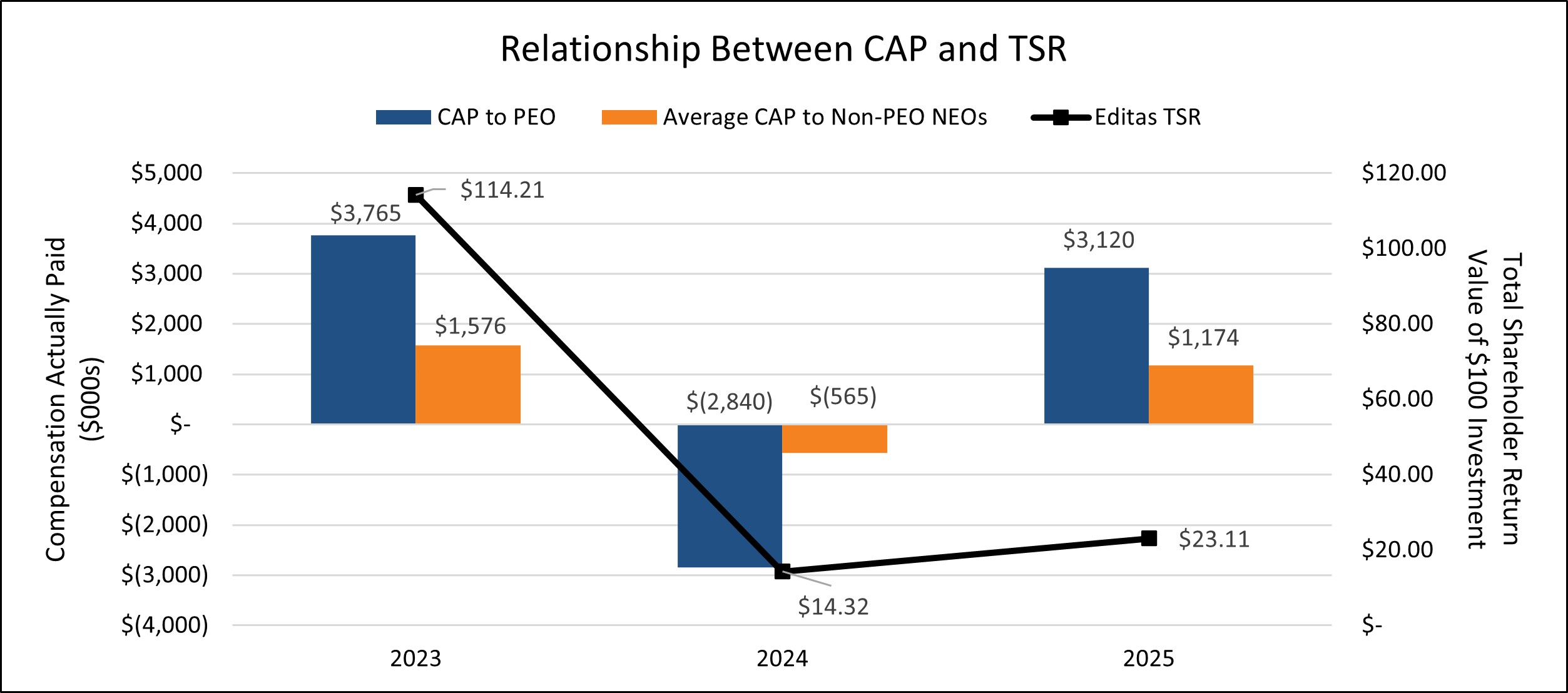
50
CAP and Net Income (Loss)
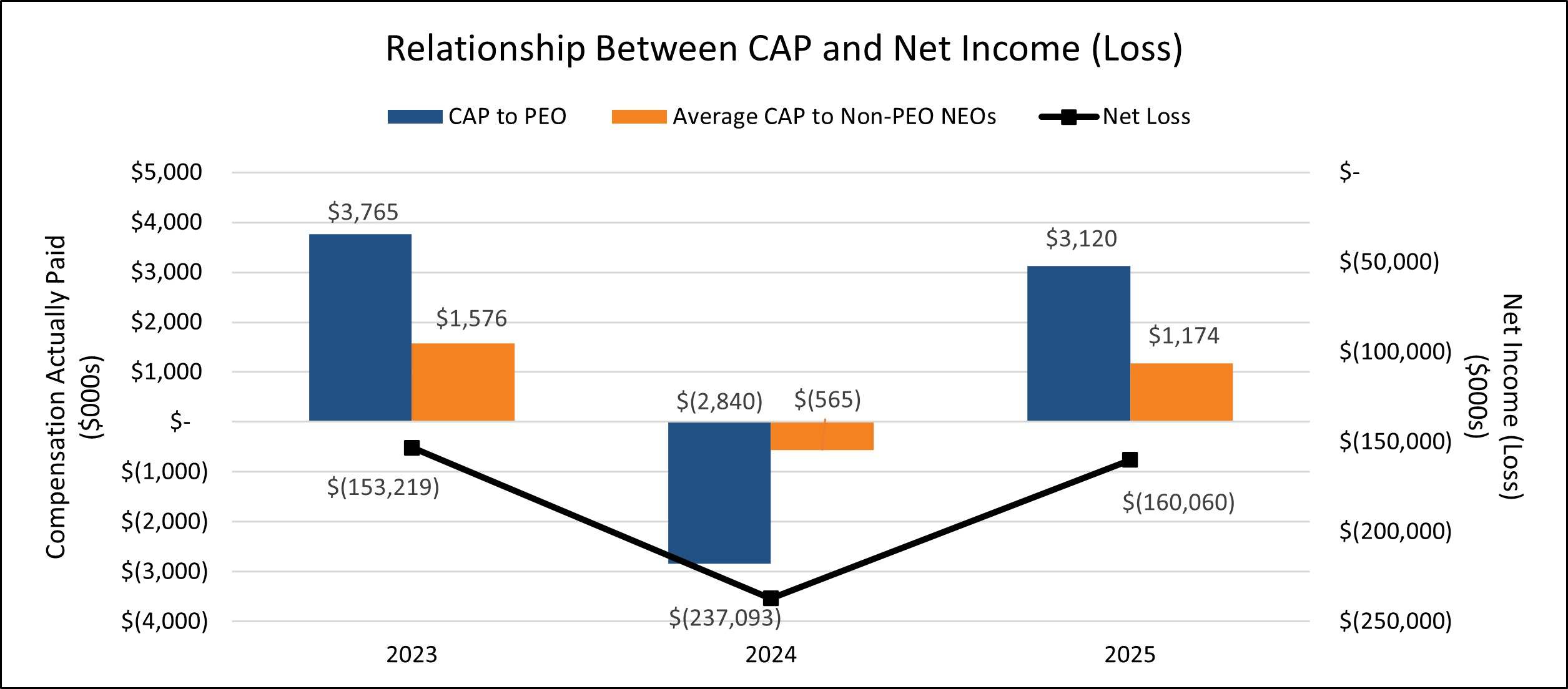
Policies and Practices Related to the Grant of Certain Equity Awards
We grant stock options to our employees and directors on an annual basis. We also grant stock options to individuals upon hire, and may do so for promotion or for retention purposes. We currently do not grant stock appreciation rights or similar option-like instruments. During the last fiscal year, none of the Board, the Compensation Committee nor our Chief Executive Officer took material nonpublic information into account when determining the timing or terms of stock options. Stock options are not granted in anticipation of the release of material nonpublic information, and the release of material nonpublic information is not timed on the grant dates of such stock options. We have not timed the disclosure of material nonpublic information for the purpose of affecting the value of executive compensation.
While we do not have any policy or obligation that requires us to grant annual stock options to employees on specified dates , annual stock option grants to our officers are typically approved by the Board of the Compensation Committee in February with an effective date following the second business day after the issuance of our earnings release for the last completed fiscal year. Annual stock option grants to employees other than officers are typically made by our Chief Executive Officer on the same effective date pursuant to delegated authority under our 2015 Plan. Pursuant to our non-employee director compensation program, our annual stock option grants to directors are made automatically and without the need for further Board action on the first Board meeting held after each annual meeting of stockholders.
Other Agreements
We also entered into employee confidentiality, non-solicitation, non-competition and proprietary information agreements with each of our named executive officers. Under these agreements, each of our named executive officers has agreed:
•not to compete with us during his or her employment and for a period of one year after the termination of his or her employment,
•not to solicit our employees during his or her employment and for a period of one year after the termination of his or her employment,
•to protect our confidential and proprietary information, and
•to assign to us related intellectual property developed during the course of his or her employment.
51
Director Compensation
Under our director compensation program, we pay our non-employee directors a cash retainer for service on the Board and for each committee on which the director serves. The chair of our Board and of each committee receive higher retainers for such service. These fees are payable in arrears in four equal quarterly installments on the last day of each quarter, provided that the amount of such payment is prorated for any portion of such quarter that the director was not serving on our Board or the relevant committee thereof. Dr. O’Neill, our Chief Executive Officer, receives no compensation for his service as a director. The compensation earned by Dr. O’Neill during 2025 is presented in the “Summary Compensation Table” above. The fees paid in 2025 to non-employee directors for service on the Board and for service on each committee of the Board on which the director is a member were as follows:
| Member Annual Fee | Chair Annual Fee | |||||||
| Board of Directors | $ | 40,000 | $ | 75,000 | ||||
| Audit Committee | $ | 8,750 | $ | 18,750 | ||||
| Organization, Leadership and Compensation Committee | $ | 7,500 | $ | 15,000 | ||||
| Nominating and Corporate Governance Committee | $ | 5,000 | $ | 10,000 | ||||
| Science and Technology Committee(1) | $ | 5,000 | $ | 10,000 | ||||
(1) The Board dissolved the Science and Technology Committee in December 2024.
Any non-employee director serving as the Board-appointed lead independent director also receives an annual fee of $25,000, in addition to any fees such director receives for his or her service on the Board or any committees thereof.
We also reimburse our non-employee directors for reasonable travel and other expenses incurred in connection with attending our Board and committee meetings. Additionally, our Board may establish other committees from time to time that include fees for both members and chairpersons, as well as per meeting fees.
In addition, under our director compensation program in effect in 2025, each non-employee director received under our 2015 Plan, upon his or her initial election to our Board, a stock option having a grant date fair value of $600,000, as calculated by us in accordance with ASC Topic 718, subject to a specified maximum number of shares. Each of these options vests as to one-third of the shares of our common stock underlying such option on each anniversary of the grant date until the third anniversary of the grant date, subject to the non-employee director’s continued service as a director through such vesting date. Further, on the date of the first Board meeting held after each annual meeting of stockholders, each non-employee director that has served on the Board for at least four months receives, under our 2015 Plan, a stock option having a grant date fair value of $300,000, as calculated by us in accordance with ASC Topic 718, and subject to a specified maximum number of shares, with the terms of such option as set forth in this paragraph. Each of these options vest in full on the one-year anniversary of the grant date, subject to the non-employee director’s continued service as a director through such vesting date. All options issued to our non-employee directors under our director compensation program are issued at exercise prices equal to the fair market value of our common stock on the date of grant and become exercisable in full upon a change in control of our company.
In December 2025, the Board amended the director compensation program, effective immediately, to provide that non-employee directors shall receive upon initial election to the Board an option to purchase 103,400 shares and an annual option grant to purchase 51,700 shares, replacing the previous grant date fair value amounts and related maximum numbers of shares. The cash compensation under the program was not adjusted.
The following table sets forth information regarding compensation earned by our non-employee directors during the year ended December 31, 2025.
| Name | Fees earned or paid in cash ($) | Option awards ($)(1) | Total ($) | ||||||||
| Bernadette Connaughton | 60,000 | 52,463 | 112,463 | ||||||||
| Andrew Hirsch | 66,250 | 52,463 | 118,713 | ||||||||
| Jessica Hopfield, Ph.D. | 93,750 | 52,463 | 146,213 | ||||||||
| Elliott Levy, M.D. | 48,750 | 52,463 | 101,213 | ||||||||
| David T. Scadden, M.D. | 47,500 | 52,463 | 99,963 | ||||||||
52
(1)Reflects the aggregate grant date fair value of option awards granted during the year in question calculated in accordance with the provisions of ASC Topic 718, Stock-Based Compensation. See Note 12 to our audited consolidated financial statements appearing in our 2025 Annual Report for assumptions underlying the valuation of equity awards. The aggregate number of shares of common stock underlying stock options outstanding as of December 31, 2025 and held by our non-employee directors were: Ms. Connaughton: 137,232; Mr. Hirsch: 181,728; Dr. Hopfield: 170,190; Dr. Levy: 112,500; and Dr. Scadden: 158,652.
Securities Authorized for Issuance Under Our Equity Compensation Plans
The following table contains information about our equity compensation plans as of December 31, 2025.
Equity Compensation Plan Information
| Plan category | Number of securities to be issued upon exercise of outstanding options, restricted stock units and rights | Weighted-average exercise price of outstanding options, warrants and rights(1) | Number of securities remaining available for future issuance under equity compensation plans (excluding securities reflected in column(a)) | ||||||||
| (a) | (b) | (c) | |||||||||
| Equity compensation plans approved by security holders(2) | 7,977,746 | $7.96 | 14,948,335 | ||||||||
| Equity compensation plans not approved by security holders(3) | 1,085,709 | $11.18 | — | ||||||||
| Total | 9,063,455 | $8.34 | 14,948,335 | ||||||||
(1)The calculations do not take into account the 659,761 shares of common stock subject to outstanding RSUs, since RSUs have no exercise price.
(2)Consists of our 2015 Plan, as amended, and our 2015 Employee Stock Purchase Plan (the “2015 ESPP”). The 2015 ESPP provides for further annual increases, to be added as of the first day of each fiscal year until, and including, January 1, 2026, in an amount equal to the least of 769,230 shares of our common stock, 1% of the total number of shares of our common stock outstanding on the first day of the applicable year, and an amount determined by our Board. The Board determined not to increase the number of shares available for future issuance under the 2015 ESPP in 2026.
(3)Consists of outstanding stock option awards approved by our Board as inducements material to the acceptance of employment of each of Drs. O'Neill and Burkly in accordance with Nasdaq Listing Rule 5635(c)(4). Dr. O’Neill was granted a stock option to purchase 950,209 shares of our common stock. His award was granted on June 2, 2022 and had an exercise price of $11.54 per share. Dr. Burkly was granted a stock option to purchase 135,500 shares of our common stock. Her award was granted on July 24, 2023 and had an exercise price of $8.66 per share. The exercise price for each of the foregoing inducement stock option awards was equal to the closing price per share of our common stock on the date of grant. For a discussion of the vesting terms of those awards granted to our named executive officers, see “—Outstanding Equity Awards at Fiscal Year-End.”
53
TRANSACTIONS WITH RELATED PERSONS
The following is a description of transactions since January 1, 2024 to which we have been a party, and in which any of our directors, executive officers and holders of more than 5% of our voting securities and affiliates of our directors, executive officers and holders of more than 5% of our voting securities, had or will have a direct or indirect material interest. We believe that all of the transactions described below were made on terms no less favorable to us than could have been obtained from unaffiliated third parties.
Employment Agreements
See the “Executive Compensation—Employment, Severance, Change in Control Arrangements, and Separation Arrangements” and “Director Compensation” sections of this Proxy Statement for a further discussion of these arrangements.
Indemnification of Officers and Directors
Our restated certificate of incorporation provides that we will indemnify our directors and officers to the fullest extent permitted by Delaware law. In addition, we have entered into indemnification agreements with our current and former directors that may be broader in scope than the specific indemnification provisions contained in the General Corporation Law of the State of Delaware.
54
PRINCIPAL STOCKHOLDERS
The following table sets forth information with respect to the beneficial ownership of our common stock, as of April 20, 2026 by:
•each person known by us to beneficially own more than 5% of our common stock;
•each of our current directors;
•each of our named executive officers; and
•all of our executive officers and directors as a group.
The column entitled “Percentage of Shares Beneficially Owned” is based on a total of 97,905,938 shares of our common stock outstanding as of April 20, 2026.
The number of shares beneficially owned by each stockholder is determined under rules issued by the Securities and Exchange Commission and includes voting or investment power with respect to securities. Under these rules, beneficial ownership includes any shares as to which the individual or entity has sole or shared voting power or investment power. In computing the number of shares beneficially owned by an individual or entity and the percentage ownership of that person, shares of common stock subject to options, warrants, or other rights held by such person that are currently exercisable or will become exercisable within 60 days after April 20, 2026 are considered outstanding, although these shares are not considered outstanding for purposes of computing the percentage ownership of any other person. Unless otherwise indicated, the address of all listed stockholders is 11 Hurley Street, Cambridge, Massachusetts 02141. Each of the stockholders listed has sole voting and investment power with respect to the shares beneficially owned by the stockholder unless noted otherwise, subject to community property laws where applicable.
| Name of Beneficial Owner | Shares Beneficially Owned | Percentage of Shares Beneficially Owned | ||||||
| 5% Stockholders | ||||||||
| The Vanguard Group, Inc.(1) | 6,679,450 | 6.8% | ||||||
| BlackRock Inc.(2) | 6,539,082 | 6.7% | ||||||
| Named Executive Officers and Directors | ||||||||
| Linda C. Burkly, Ph.D.(3) | 270,895 | * | ||||||
| Bernadette Connaughton(4) | 137,232 | * | ||||||
| Andrew Hirsch(5) | 183,728 | * | ||||||
| Jessica Hopfield, Ph.D.(6) | 237,890 | * | ||||||
| Elliott Levy, M.D.(7) | 112,500 | * | ||||||
| Gilmore O’Neill, M.B., M.M.Sc.(8) | 1,811,977 | 1.9% | ||||||
| Amy Parison(9) | 122,427 | * | ||||||
David T. Scadden, M.D.(10) | 158,652 | * | ||||||
All executive officers and directors as a group (8 persons)(11) | 3,035,301 | 3.1% | ||||||
*Less than 1%.
(1)The Vanguard Group, Inc. (“Vanguard”) has shared voting power with respect to 48,440 shares, sole dispositive power with respect to 6,562,065 shares and shared dispositive power with respect to 117,385 shares. The principal business address of Vanguard and its related entities is 100 Vanguard Blvd., Malvern, PA 19355. The number of shares we have reported as beneficially owned by Vanguard (and the other information in this footnote) is based on a Schedule 13G/A filed by Vanguard with the SEC on November 12, 2024 reporting beneficial ownership as of September 30, 2024. Vanguard subsequently reported on a Schedule 13G/A filed with the SEC on March 26, 2026 that due to an internal realignment it no longer has, or is deemed to have, beneficial ownership over company shares beneficially owned by various Vanguard subsidiaries and/or business divisions. Vanguard also reported that certain subsidiaries or business divisions that formerly had, or were deemed to have, beneficial ownership with Vanguard, will report beneficial ownership separately (on a disaggregated basis).
(2)BlackRock, Inc. has sole voting power with respect to 6,436,389 shares and sole dispositive power over 6,539,082 shares. BlackRock, Inc.’s principal business address is 50 Hudson Yards, New York, NY 10001. The number of shares we have reported as beneficially owned by BlackRock, Inc. (and the other information in this footnote) is based on a
55
Schedule 13G/A filed by BlackRock, Inc. with the SEC on April 17, 2025 reporting beneficial ownership as of March 31, 2025.
(3)Consists of (i) 27,243 shares of common stock, (ii) 242,102 shares of common stock issuable upon the exercise of options exercisable within 60 days after April 20, 2026, and (iii) 1,550 shares of common stock to be received upon the vesting of RSUs within 60 days after April 20, 2026.
(4)Consists of 137,232 shares of common stock issuable upon the exercise of options exercisable within 60 days after April 20, 2026.
(5)Consists of (i) 2,000 shares of common stock and (ii) 181,728 shares of common stock issuable upon the exercise of options exercisable within 60 days after April 20, 2026.
(6)Consists of (i) 67,700 shares of common stock and (ii) 170,190 shares of common stock issuable upon the exercise of options exercisable within 60 days after April 20, 2026.
(7)Consists of 112,500 shares of common stock issuable upon the exercise of options exercisable within 60 days after April 20, 2026.
(8)Consists of (i) 164,180 shares of common stock, (ii) 1,614,840 shares of common stock issuable upon the exercise of options exercisable within 60 days after April 20, 2026, and (iii) 32,957 shares of common stock to be received upon the vesting of RSUs within 60 days after April 20, 2026.
(9)Consists of (i) 7,188 shares of common stock, (ii) 114,267 shares of common stock issuable upon the exercise of options exercisable within 60 days after April 20, 2026, and (iii) 972 shares of common stock to be received upon the vesting of RSUs within 60 days after April 20, 2026.
(10)Consists of 158,652 shares of common stock issuable upon the exercise of options exercisable within 60 days after April 20, 2026.
(11)Consists of (i) 268,311 shares of common stock, (ii) 2,731,511 shares of common stock issuable upon the exercise of options exercisable within 60 days after April 20, 2026, and (iii) 35,479 shares of common stock to be received upon the vesting of RSUs within 60 days after April 20, 2026.
56
DELINQUENT SECTION 16(a) REPORTS
Under Section 16(a) of the Securities Exchange Act of 1934, our directors and officers and significant stockholders (defined by statute as stockholders beneficially owning more than 10% percent of our common stock) are required to file with the SEC reports of ownership, and changes in ownership, of our common stock. Based solely on a review of the reports filed with the SEC or representations that no form was required, we believe that, during the fiscal year ended December 31, 2025, all of our officers, directors and significant stockholders timely filed all required reports under Section 16(a), except that, due to administrative error, each of Drs. O’Neill and Burkly disclosed late on a Form 4 filed on March 27, 2025 the grant of stock options that were granted on March 8, 2025.
57
REPORT OF THE AUDIT COMMITTEE
The Audit Committee has reviewed our audited financial statements for the year ended December 31, 2025 and discussed them with our management and our independent registered public accounting firm, Ernst & Young LLP.
The Audit Committee has also received from, and discussed with, Ernst & Young LLP various communications that Ernst & Young LLP is required to provide to the Audit Committee, including the matters required to be discussed by the applicable requirements of the Public Company Accounting Oversight Board and the Securities and Exchange Commission.
In addition, Ernst & Young LLP provided the Audit Committee with the written disclosures and the letter required by applicable requirements of the Public Company Accounting Oversight Board regarding the independent registered public accounting firm’s communications with the Audit Committee concerning independence, and the Audit Committee has discussed with the company’s independent registered public accounting firm their independence.
Based on the review and discussions referred to above, the Audit Committee recommended to our Board that our financial statements audited by Ernst & Young LLP be included in our Annual Report on Form 10-K for the year ended December 31, 2025.
By the Audit Committee of the board of directors of Editas Medicine, Inc. | |||||
Andrew Hirsch, Chair Jessica Hopfield, Ph.D. Elliott Levy, M.D. | |||||
58
PROPOSAL 2—ADVISORY VOTE ON EXECUTIVE COMPENSATION
We are providing our stockholders the opportunity to vote to approve, on an advisory, non-binding basis, the compensation of our named executive officers as disclosed in this Proxy Statement in accordance with the SEC’s rules. This proposal, which is commonly referred to as “say-on-pay,” is required by the Dodd-Frank Act and Consumer Protection Act of 2010, which added Section 14A to the Securities Exchange Act of 1934 (the “Exchange Act”). Our executive compensation program is designed to attract and retain qualified and talented executives, motivate such executives to achieve our business goals and reward them for short- and long-term performance with a simple and clear compensation structure. Under this program, our named executive officers are rewarded for the achievement of our short- and long-term performance, which we believe serves to enhance short- and long-term value creation for our stockholders. The program contains elements of cash and equity-based compensation and are designed to align the interests of our executives with those of our stockholders and paying for performance.
The section of this Proxy Statement titled “Executive Compensation” describes in detail our executive compensation program and the decisions made by the Organization, Leadership and Compensation Committee of our Board (the “Compensation Committee”). As we describe in greater detail in the “Overview of Executive Officer Compensation” section, our executive compensation program rewards value creation for stockholders and progress towards achieving our business goals and that promotes company performance. At the same time, we believe our program does not encourage excessive risk-taking by management. While we do not have a formal or informal policy for allocating between long-term and short-term compensation, between cash and non-cash compensation or among different forms of non-cash compensation, we generally strive to provide our named executive officers with a mix of short-term and long-term performance-based incentives to encourage consistently strong performance, and our Board believes that this link between compensation and the achievement of our near- and long-term business goals has helped drive our performance over time.
Our Board is asking stockholders to approve a non-binding advisory vote on the following resolution:
RESOLVED, that the compensation paid to the company’s named executive officers, as disclosed pursuant to the compensation disclosure rules of the Securities and Exchange Commission, including the compensation tables and any related material disclosed in this Proxy Statement, is hereby approved.
As an advisory vote, this proposal is not binding. The outcome of this advisory vote does not overrule any decision by us or our Board (or any committee thereof), create or imply any change to the fiduciary duties of our company or our Board (or any committee thereof), or create or imply any additional fiduciary duties for our company or our Board (or any committee thereof). However, the Compensation Committee and Board value the opinions expressed by our stockholders in their vote on this proposal and intend to consider carefully the outcome of the vote when making future compensation decisions for named executive officers.
Recommendation of the Board of Directors
OUR BOARD OF DIRECTORS RECOMMENDS THAT STOCKHOLDERS VOTE TO APPROVE THE COMPENSATION PAID TO OUR NAMED EXECUTIVE OFFICERS BY VOTING ‘FOR’ THIS PROPOSAL.
59
PROPOSAL NO. 3—RATIFICATION OF THE APPOINTMENT OF PRICEWATERHOUSECOOPERS LLP
AS OUR INDEPENDENT REGISTERED PUBLIC ACCOUNTING FIRM FOR THE
FISCAL YEAR ENDING DECEMBER 31, 2026
Our stockholders are being asked to ratify the appointment by the Audit Committee of PricewaterhouseCoopers LLP (“PwC”) as our independent registered public accounting firm for the fiscal year ending December 31, 2026.
The Audit Committee is solely responsible for selecting our independent registered public accounting firm for the fiscal year ending December 31, 2026. Stockholder approval is not required to appoint PwC as our independent registered public accounting firm. However, our Board believes that submitting the appointment of PwC to the stockholders for ratification is good corporate governance. If the stockholders do not ratify this appointment, the Audit Committee will reconsider whether to retain PwC. If the selection of PwC is ratified, the Audit Committee, in its discretion, may direct the appointment of a different independent registered public accounting firm at any time it decides that such a change would be in the best interest of our company and our stockholders.
A representative of PwC is expected to attend the virtual Annual Meeting and will have an opportunity to make a statement if he or she desires to do so and to respond to appropriate questions from our stockholders.
Recent Change in Auditor
As reported in our Current Report on Form 8-K filed on April 7, 2026, on April 1, 2026, the Audit Committee (i) dismissed Ernst & Young LLP (“E&Y”) as our independent registered public accounting firm and (ii) appointed PricewaterhouseCoopers LLP (“PwC”) to serve as our new independent registered public accounting firm for the fiscal year ending December 31, 2026. The Audit Committee made its decision after soliciting proposals from other accounting firms and conducting a thorough formal review. We notified E&Y of our decision on April 2, 2026.
The reports of E&Y on our consolidated financial statements as of and for the fiscal years ended December 31, 2024 and December 31, 2025 did not contain an adverse opinion or disclaimer of opinion, nor were they qualified or modified as to uncertainty, audit scope, or accounting principles.
During our fiscal years ended December 31, 2024 and December 31, 2025, and the subsequent interim period through April 1, 2026, there were no (i) “disagreements” (as defined in Item 304(a)(1)(iv) of Regulation S-K and the related instructions) between us and E&Y on any matter of accounting principles or practices, financial statement disclosure, or auditing scope or procedure which, if not resolved to E&Y’s satisfaction, would have caused E&Y to make reference to the subject matter of the disagreements in conjunction with its report on our consolidated financial statements for the relevant year, or (ii) “reportable events” (as defined in Item 304(a)(1)(v) of Regulation S-K).
We previously provided E&Y with a copy of the disclosures in the our Current Report on Form 8-K filed on April 7, 2026, and requested that E&Y furnish us with a letter addressed to the Securities and Exchange Commission stating whether it agrees with such disclosure and, if not, stating the respects in which it does not agree. A copy of E&Y’s letter dated April 7, 2026, was filed as Exhibit 16.1 to the Current Report on Form 8-K.
During the fiscal years ended December 31, 2024 and December 31, 2025, and the subsequent interim period through April 1, 2026, neither we, nor anyone on our behalf, consulted with PwC regarding either (i) the application of accounting principles to a specified transaction, either completed or proposed, or the type of audit opinion that might be rendered with respect to our consolidated financial statements, and no written report or oral advice was provided to us by PwC that PwC concluded was an important factor considered by us in reaching a decision as to any accounting, auditing or financial reporting issue; or (ii) any matter that was the subject of a “disagreement” (as defined in Item 304(a)(1)(iv) of Regulation S-K and the related instructions) or a “reportable event” (as defined in Item 304(a)(1)(v) of Regulation S-K).
60
Audit Fees Paid to Ernst & Young
We incurred the following fees from E&Y for the audit of the consolidated financial statements and for other services provided during the years ended December 31, 2025 and 2024.
| 2025 | 2024 | |||||||
| Audit fees(1) | $ | 705,000 | $ | 878,125 | ||||
| Audit-related fees | — | — | ||||||
| Tax fees(2) | 41,200 | 110,000 | ||||||
All other fees | — | — | ||||||
| Total fees | $ | 746,200 | $ | 988,125 | ||||
(1)Audit fees consist of fees for the audit of our annual consolidated financial statements included in our annual reports on Form 10-K, the review of the interim consolidated financial statements included in our quarterly reports on Form 10-Q, and other professional services provided in connection with registration statements filed with the SEC.
(2)Tax fees consist of fees for professional services performed by E&Y with respect to tax compliance, tax advice, and tax planning.
The aggregate fees included in the Audit Fees are those billed for the fiscal year and the Tax Fees are those fees billed in the fiscal year.
Audit Committee Pre-Approval Policy and Procedures
The Audit Committee has adopted policies and procedures for the pre-approval of audit and non-audit services for the purpose of maintaining the independence of our independent auditor. We may not engage our independent auditor to render any audit or non-audit service unless either the service is approved in advance by the Audit Committee, or the engagement to render the service is entered into pursuant to the Audit Committee’s pre-approval policies and procedures. Notwithstanding the foregoing, pre-approval is not required with respect to the provision of services, other than audit, review or attest services, by the independent auditor if the aggregate amount of all such services is no more than 5% of the total amount paid by us to the independent auditor during the fiscal year in which the services are provided, such services were not recognized by us at the time of the engagement to be non-audit services and such services are promptly brought to the attention of the Audit Committee and approved prior to completion of the audit by the Audit Committee.
From time to time, the Audit Committee may pre-approve services that are expected to be provided to us by the independent auditor during the following 12 months. At the time such pre-approval is granted, the Audit Committee must identify the particular pre-approved services in a sufficient level of detail so that our management will not be called upon to make a judgment as to whether a proposed service fits within the pre-approved services and, at each regularly scheduled meeting of the Audit Committee following such approval, management or the independent auditor shall report to the Audit Committee regarding each service actually provided to us pursuant to such pre-approval. The Audit Committee has delegated to its chair the authority to grant pre-approvals of audit or non-audit services to be provided by the independent auditor. Any approval of services by the chair of the Audit Committee is reported to the committee at its next regularly scheduled meeting.
During our 2025 and 2024 fiscal years, no services were provided to us by E&Y other than in accordance with the pre-approval policies and procedures described above.
Recommendation of the Board of Directors
OUR BOARD OF DIRECTORS RECOMMENDS VOTING “FOR” THE RATIFICATION OF THE APPOINTMENT OF PRICEWATERHOUSECOOPERS LLP AS OUR INDEPENDENT REGISTERED PUBLIC ACCOUNTING FIRM FOR THE FISCAL YEAR ENDING DECEMBER 31, 2026.
61
HOUSEHOLDING
Some banks, brokers and other nominee record holders may be participating in the practice of “householding” proxy statements, annual reports, and Notices of Internet Availability of Proxy Materials (a “Notice”). This means that only one copy of our documents, including the Notice, may have been sent to multiple stockholders who share an address. We will promptly deliver a separate copy of any such document to you upon written or oral request to Editas Medicine, Inc., 11 Hurley Street, Cambridge, Massachusetts 02141, Attention: Investor Relations, telephone: 617-401-9000. If you want to receive separate copies of our proxy statements, annual reports, or Notices in the future, or if you are receiving multiple copies and would like to receive only one copy per household, you should contact your bank, broker or other nominee record holder, or you may contact us at the above address and phone number.
STOCKHOLDER PROPOSALS
A stockholder who would like to have a proposal considered for inclusion in our 2027 proxy statement must submit the proposal in accordance with the procedures outlined in Rule 14a-8 of the Exchange Act so that it is received by us no later than December 29, 2026. However, if the date of the 2027 annual meeting of stockholders is changed by more than 30 days from the date of the previous year’s meeting, then the deadline is a reasonable time before we begin to print and send our proxy statement for the 2027 annual meeting of stockholders. SEC rules set standards for eligibility and specify the types of stockholder proposals that may be excluded from a proxy statement. Stockholder proposals should be addressed to Editas Medicine, Inc., 11 Hurley Street, Cambridge, Massachusetts 02141, Attention: Corporate Secretary.
If a stockholder wishes to propose a nomination of persons for election to our Board or present a proposal at an annual meeting but does not wish to have the proposal considered for inclusion in our proxy statement and proxy card, our amended and restated by-laws establish an advance notice procedure for such nominations and proposals. Stockholders at an annual meeting may only consider proposals or nominations specified in the notice of meeting or brought before the meeting by or at the direction of our Board or by a stockholder of record on the record date for the meeting, who is entitled to vote at the meeting and who has delivered timely notice in proper form to our corporate secretary of the stockholder’s intention to bring such business before the meeting.
The required notice must be in writing and received by our corporate secretary at our principal executive offices not less than 90 days nor more than 120 days prior to the first anniversary of the preceding year’s annual meeting. However, in the event that the date of the annual meeting is advanced by more than 30 days, or delayed by more than 60 days, from the first anniversary of the preceding year’s annual meeting, a stockholder’s notice must be so received no earlier than the 120th day prior to such annual meeting and not later than the close of business on the later of (A) the 90th day prior to such annual meeting and (B) the tenth day following the day on which notice of the date of such annual meeting was given or public disclosure of the date of such annual meeting was made, whichever first occurs. For stockholder proposals to be brought before the 2027 annual meeting of stockholders, the required notice must be received by our corporate secretary at our principal executive offices no earlier than February 17, 2027 and no later than March 19, 2027. Stockholders are advised to review our bylaws which also specify requirements as to the form and content of a stockholder’s notice, including the information required by Rule 14a-19 under the Exchange Act.
OTHER MATTERS
Our Board does not know of any other matters to be brought before the Annual Meeting. If any other matters not mentioned in this Proxy Statement are properly brought before the meeting, the individuals named in the enclosed proxy intend to use their discretionary voting authority under the proxy to vote the proxy in accordance with their best judgment on those matters.
62